
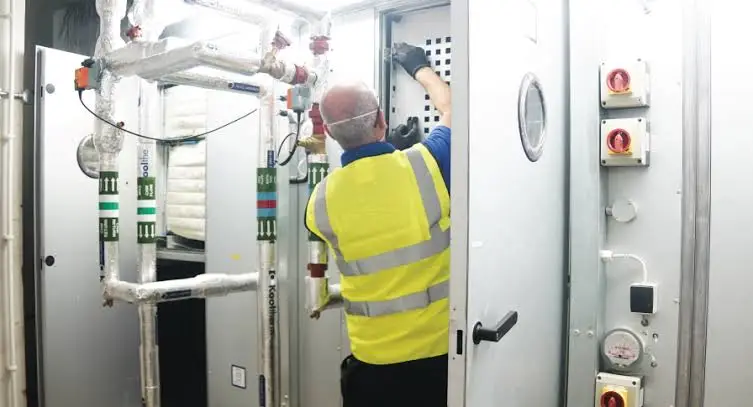
Air handling units rarely get attention when they are working. They sit on rooftops and in plant rooms, quietly moving, filtering, heating, and cooling the air that every occupant breathes. It is only when a belt snaps, a drain pan overflows onto a ceiling, or a coil freezes that someone remembers they exist.
Good air handling unit maintenance is what keeps that from happening. It protects indoor air quality, controls energy use, and prevents the failures that tend to land on the hottest day of summer or the coldest morning of winter.
This guide covers what an AHU is made of, how often each part needs attention, and a complete AHU maintenance checklist you can adapt to your own equipment. It also explains the most common faults, which spares to hold, and how to keep records so the work actually gets done.
What an Air Handling Unit Does
An air handling unit is the part of an HVAC system that conditions and moves air. It draws in return air and, usually, some outside air, filters it, heats or cools it, adjusts humidity where required, and pushes it through ductwork to the spaces it serves. AHUs are found on rooftops, in mechanical rooms, and in utility spaces, and their layout varies widely from one building to the next.
Because they touch almost every part of the air system, a problem in an AHU shows up everywhere: uneven temperatures, stale air, noise, condensation, rising energy bills, and complaints.
The Main Components You Need to Maintain
Knowing the parts makes the checklist easier to follow. A typical AHU includes:
| Component | What it does | What goes wrong |
|---|---|---|
| Supply and return fans (blowers) | Move air through the unit and ductwork | Worn bearings, imbalance, motor faults, failed relays or capacitors |
| Fan motors and drives | Power the fans | Overheating, vibration, loose mounts, electrical faults |
| Belts and sheaves (pulleys) | Transfer power from motor to fan | Wear, cracking, slippage, misalignment |
| Filter racks and filters | Remove particles from the air | Clogging, bypass around the frame, wrong filter type |
| Heating coils | Warm the air | Fouling, leaks, damaged fins |
| Cooling coils | Cool and dehumidify the air | Fouling, frozen coils, corroded or bent fins |
| Drain pans and condensate lines | Remove condensation | Standing water, algae, blockages, overflow |
| Humidifiers | Add moisture in dry conditions | Scale, failed valves, contamination |
| Dampers and actuators | Control outside, return, relief, and bypass airflow | Stuck blades, failed linkages, actuators not following commands |
| Heat recovery devices | Pre-condition incoming air using exhaust air | Fouling, leakage, seized components |
| Controls and sensors | Regulate temperature, pressure, and airflow | Drift, loose wiring, failed sensors, wrong setpoints |
Why Air Handling Unit Maintenance Matters
Indoor air quality. Dirty filters, damp drain pans, and fouled coils affect what occupants breathe. In some buildings, such as schools and healthcare facilities, this carries added importance.
Energy use. Clogged filters and dirty coils make fans and compressors work harder to deliver the same result.
Equipment life. Lubrication, correct belt tension, and clean components reduce wear on motors, bearings, and drives.
Fewer emergency calls. Many AHU failures give warning signs such as noise, vibration, rising amp draw, and weak airflow. Regular checks catch them early.
Compliance and documentation. Some jurisdictions and building types expect documented HVAC maintenance as part of operating requirements. Records protect you in an audit or incident review.
Comfort and productivity. Occupants notice stuffy rooms and temperature swings long before anyone checks a coil.
Before You Start: Safety and Preparation
AHU work involves rotating machinery, electrical equipment, and sometimes working at height. Keep these basics in place:
- Follow the manufacturer’s instructions for the specific unit, and do not carry out tasks you are not trained or authorised to perform.
- Apply lockout and tagout before opening access panels or touching fans, belts, or electrical components.
- Isolate and verify that power is off and the fan has stopped completely.
- Use proper PPE, such as gloves, eye protection, and respiratory protection when cleaning coils or handling dirty filters.
- Take care with chemicals. Use coil cleaners and drain treatments as directed and ventilate the area.
- Use safe access. Rooftop units need safe routes, fall protection where required, and awareness of weather.
- Leave refrigerant, gas, and high-voltage work to qualified technicians.
- Have a plan for the building. Tell occupants and the BMS operator if a unit will be offline.
The Complete AHU Maintenance Checklist
The checklist below groups tasks by area and suggests typical frequencies. Treat the frequencies as starting points. Always check manufacturer guidance, local requirements, and the conditions in your building, such as dust levels, outdoor air quality, and operating hours.
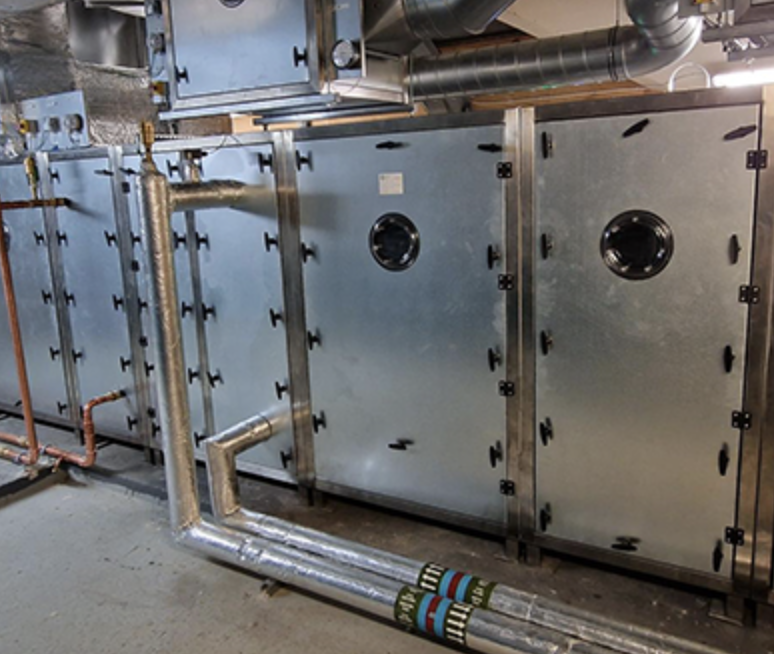
1. Electrical and Controls
Monthly or at each visit
- Inspect the electrical disconnect for damage, heat discolouration, and secure mounting
- Check the control panel and enclosures for warning lights, loose wiring, moisture, and dust
- Record operating amps on the supply fan motor, and on return and exhaust motors where fitted, and compare with previous readings and nameplate values
Quarterly or semi-annually
- Inspect contactors and starters for pitting, wear, and overheating
- Tighten electrical connections to the manufacturer’s specification, with power isolated
- Verify control setpoints against the intended sequence of operation
- Test and calibrate temperature, humidity, and pressure sensors against a reference
- Replace thermostat or sensor batteries where applicable
- Check heater safeties and limit controls where fitted
2. Filters and Filter Section
Monthly
- Inspect all filters for loading, damage, and moisture
- Check the pressure drop across the filter bank if gauges or sensors are fitted
- Confirm filters are seated correctly and that there are no gaps allowing bypass
Every one to three months, or as loading dictates
- Replace filters, more often in dusty, high-traffic, or high-pollen environments
- Use the grade of filter specified for the space, such as higher-efficiency filters for sensitive areas
Semi-annually
- Inspect filter racks, frames, and seals, and repair or replace damaged parts
- Check the area upstream and downstream of the filters for dust and debris
3. Coils: Heating and Cooling
Quarterly
- Inspect coil faces for dirt, debris, and fin damage
- Measure the temperature difference across the coil and compare with expected values
Semi-annually
- Clean heating and cooling coils using an approved coil cleaner or low-pressure method, taking care not to bend fins
- Straighten bent fins with a fin comb
- Check for corrosion, leaks, and signs of freezing
- Inspect and clean the drain pan beneath the cooling coil (see below)
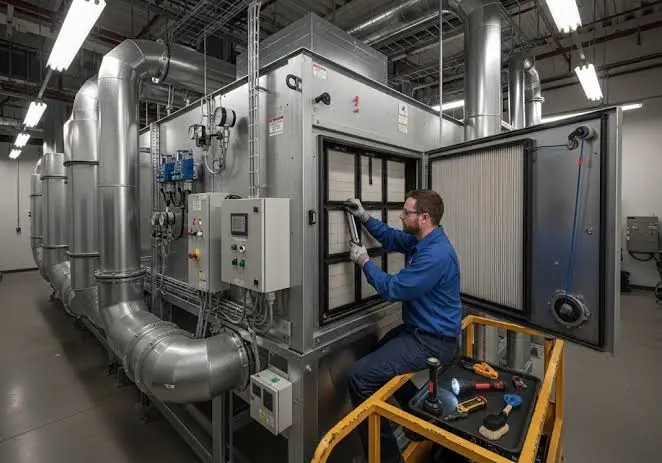
Seasonally
- Verify heating and cooling valves operate through their full range
- Check freeze protection devices before winter
4. Drain Pans and Condensate Lines
Monthly during cooling season
- Inspect drain pans for standing water, algae, slime, rust, and debris
- Confirm condensate flows freely to the drain
Quarterly
- Clean drain pans and flush condensate lines
- Clear blockages using a wet and dry vacuum or compressed air, as appropriate
- Check traps, float switches, and overflow protection
- Apply drain pan treatment where your program specifies it
Standing water is a red flag. It often means a blocked line, and it can lead to overflow, ceiling damage, and microbial growth.
5. Supply, Return, and Exhaust Fans
Monthly
- Listen for unusual noise and check for vibration
- Check fan rotation direction after any electrical work
- Inspect fan housings for loose panels and air leaks
Quarterly
- Inspect fan wheels for dirt build-up, cracks, and imbalance
- Clean fan blades and housing, taking care not to disturb balance weights
- Check motor mounts and fan mounting bolts for tightness
Semi-annually
- Lubricate fan bearings and shafts as the manufacturer specifies. Avoid over-lubrication, which can damage bearings as readily as under-lubrication
- Lubricate motor bearings if they are not sealed
- Check shaft alignment and wheel clearance where accessible
6. Belts and Sheaves
Monthly
- Inspect belts for cracking, fraying, glazing, and wear
- Check belt tension and alignment
Quarterly
- Inspect sheaves for wear, grooves, and misalignment
- Replace worn belts in matched sets, and re-tension after the first few days of running
Belts that are too loose slip and reduce airflow. Belts that are too tight overload bearings.
7. Dampers and Actuators
Quarterly
- Exercise outside air, return air, relief air, and face and bypass dampers through their full travel
- Check blades, seals, and linkages for damage, corrosion, and binding
- Confirm actuators move smoothly and match the commanded position
- Verify minimum outside air settings, where applicable
Annually
- Lubricate damper linkages and pivot points as required
- Inspect seals and replace where leakage is evident
8. Humidifiers and Heat Recovery
Seasonally or per manufacturer
- Inspect humidifier components for scale, leaks, and contamination
- Clean or replace humidifier media and check valves
- Inspect heat recovery wheels, plates, or coils for fouling, damage, and correct operation
9. Casing, Insulation, and Access Doors
Quarterly
- Inspect casing panels, doors, latches, and gaskets for air leaks
- Check internal insulation for damage, moisture, and loose sections
- Make sure access doors close and seal properly
- Inspect around the unit for water staining, corrosion, and pest activity
10. Performance Checks and Record Keeping
At every scheduled visit
- Record amps, temperatures, pressures, and any airflow readings
- Compare readings with previous visits and commissioning values
- Note filter condition, belt condition, and coil cleanliness
- Photograph anything unusual
- Record parts used and time taken
- Raise work orders for defects found
Maintenance Frequency at a Glance
| Frequency | Typical AHU tasks |
|---|---|
| Monthly | Filter inspection, belt check, fan noise and vibration check, drain pan inspection in cooling season, amp readings, control panel check |
| Quarterly | Damper exercising, coil inspection, drain line cleaning, fan cleaning, sheave check, contactor and starter inspection, casing inspection |
| Semi-annually | Coil cleaning, bearing lubrication, electrical tightening, sensor calibration, filter rack inspection |
| Seasonal | Cooling or heating readiness, freeze protection checks, humidifier service |
| Annual | Full performance review, damper seal inspection, review of spares, documentation audit |
As a general rule, AHUs benefit from a thorough maintenance visit at least twice a year, with lighter checks between visits. Units serving critical spaces, dusty environments, or long operating hours may need more.
Common Air Handling Unit Problems and What to Check
Knowing the typical faults helps your team respond faster.
| Symptom | Likely causes | First checks |
|---|---|---|
| Weak airflow | Clogged filters, slipping belt, fouled coil, damper stuck, duct leakage | Filter pressure drop, belt tension, coil face, damper position |
| Unit not cooling or heating properly | Fouled coil, valve fault, sensor drift, low refrigerant or water flow | Temperature split, valve operation, sensor readings |
| Noise or vibration | Worn bearings, imbalance, loose mounts, damaged belt | Fan wheel, bearings, mounts, belt condition |
| Water leaking or overflowing | Clogged condensate line, blocked trap, overflowing pan | Drain line, pan, float switch |
| Frozen coil | Low airflow, low load, damper fault, control failure | Filters, airflow, outside air damper, freeze protection |
| Fan won’t start or keeps tripping | Electrical fault, failed contactor, relay or capacitor, overload | Disconnect, starter, motor amps, safeties |
| High energy use | Dirty coils or filters, leaking dampers, running outside schedule | Pressure drop, damper seals, schedules and setpoints |
| Poor air quality complaints | Wet pans, dirty filters, wrong filter type, bypass | Drain pan, filter seating and grade, outside air settings |
| Controls behaving erratically | Sensor drift, loose wiring, wrong setpoints | Calibration, connections, control logic |
For a systematic way to handle the alarms and codes that equipment produces, see our guides on chiller fault codes and fire alarm panel trouble codes.
Spare Parts Worth Keeping on the Shelf
Holding a small stock of the right parts turns a long outage into a short one. Common items include:
- Filters in each size and grade used
- Belts, in matched sets for each drive
- Capacitors, contactors, relays, and fuses
- Coil cleaner and drain pan treatments
- Sensors and thermostat batteries
- Lubricants specified by the manufacturer
For larger sites with several similar units, it can make sense to hold higher-value spares that are shared across equipment, such as motors, bearings, control boards, or actuators. The right stock depends on how critical each unit is and how long suppliers take to deliver.
Use Live Data to Spot Problems Between Visits
A unit can drift out of condition between scheduled visits. Building management systems and monitoring devices can track airflow, pressure, and temperature in real time, giving early warning of trouble:
- Rising filter pressure drop points to clogging
- Climbing motor amps can indicate bearing wear or belt issues
- Widening temperature split suggests coil problems
- Fan running outside its schedule wastes energy
Feeding selected signals into your maintenance system lets alarms and thresholds raise work orders automatically. Our guide on real-time asset data in a CMMS explains how to choose what to send and how to avoid alarm overload. And if you want a single number to track how well a unit performs over time, see our guide on OEE for buildings.
Documentation: Prove the Work Was Done
A checklist is only as good as the record it leaves. For each AHU, keep:
- Asset details: make, model, serial number, location, and areas served
- The manufacturer’s manual and sequence of operation
- A dated record of every inspection, cleaning, repair, and part replaced
- Operating readings over time, such as amps and temperature split
- Filter types and sizes, belt part numbers, and lubricant specifications
- Photos of condition before and after major work
- Contractor reports and certificates
This history helps plan future work, spot repeat faults, support warranty claims, and satisfy an audit.
Turn the Checklist Into a Maintenance Program
A list on paper does not maintain anything. To make it work:
- Create an asset record for each AHU. Include its location, areas served, and criticality.
- Convert the checklist into scheduled tasks. Assign frequencies, owners, and estimated times.
- Prioritise critical units. Units serving sensitive spaces, such as healthcare areas, labs, and server rooms, come first.
- Spread the workload. Avoid scheduling every unit for the same week.
- Plan around the seasons. Cooling checks before summer and heating and freeze protection checks before winter.
- Track completion. Measure how many tasks are done on time and what is overdue.
- Turn findings into work orders. A defect noted on a checklist should become a tracked repair.
- Review and adjust. Use failure history and conditions to tighten or relax intervals.
Our guide on how to start a preventive maintenance program covers the foundations in more detail.
Paper vs. Digital Checklists
Paper checklists work for a small number of units, but they are easy to lose and difficult to analyse. Digital checklists allow technicians to complete tasks on a phone or tablet, attach photos, record readings, and generate work orders for defects on the spot. They also make it simple to see which units are overdue and which keep failing.
For more on how this works, read why a CMMS is essential for preventive maintenance and how it can streamline preventive maintenance. If you are comparing platforms, FacilityBot’s CMMS software page shows how asset records, schedules, and checklists connect.
Common Mistakes in AHU Maintenance
Replacing filters on a calendar only. Loading depends on the environment, so check pressure drop and condition.
Over-lubricating bearings. More grease is not better. Follow the manufacturer’s quantity and interval.
Ignoring drain pans until they overflow. Check them regularly in cooling season.
Cleaning coils aggressively. High pressure and harsh chemicals can bend fins and damage coatings.
Replacing a single belt in a matched set. Replace belts together and re-tension after running in.
Skipping amp readings. Recorded trends reveal developing motor and bearing problems.
Neglecting dampers. Stuck or leaking dampers waste energy and upset ventilation without any obvious alarm.
Working without isolation. Always lock out and verify before opening a unit.
Keeping no records. If it is not documented, it is hard to prove, learn from, or repeat.
Treating every unit the same. Critical and heavily used units need more attention.
Frequently Asked Questions
What is air handling unit maintenance?
Air handling unit maintenance is the routine inspection, cleaning, lubrication, adjustment, and testing of an AHU’s components, including filters, coils, fans, belts, dampers, drain pans, and controls, to keep it running efficiently and prevent breakdowns.
How often should an AHU be serviced?
As a general rule, AHUs should receive a thorough service at least twice a year, with filter and visual checks monthly or quarterly in between. The right frequency depends on manufacturer guidance, operating hours, and the environment, so adjust for dusty or critical applications.
What should an AHU maintenance checklist include?
A good AHU maintenance checklist covers electrical and controls, filters, heating and cooling coils, drain pans and condensate lines, fans and motors, belts and sheaves, dampers and actuators, humidifiers and heat recovery, casing and insulation, and performance readings with record keeping.
How often should AHU filters be changed?
Many facilities inspect filters monthly and replace them every one to three months, but the right interval depends on dust levels, outdoor air quality, and filter type. Pressure drop across the filter bank is a more reliable guide than the calendar alone.
How often should AHU coils be cleaned?
Heating and cooling coils are commonly cleaned at least twice a year. Units in dusty or humid environments may need cleaning more often. A widening temperature difference across the coil can signal that cleaning is overdue.
What are the most common AHU problems?
Typical problems include clogged filters, fouled coils, failing fan motors, worn or misaligned belts and pulleys, duct leakage, blocked condensate drains, stuck dampers, and control or sensor failures.
Can I do AHU maintenance in-house?
Many routine tasks, such as filter changes, visual inspections, drain checks, and recording readings, can be done by trained in-house staff. Refrigerant work, high-voltage electrical work, gas equipment, and specialised repairs should be handled by qualified technicians. Always follow lockout and tagout procedures.
What spare parts should I keep for AHUs?
Common spares include filters, matched belt sets, capacitors, contactors, relays, fuses, sensors, lubricants, and coil and drain treatments. For larger sites with similar units, consider stocking motors, bearings, actuators, and control boards.
How does a CMMS help with AHU maintenance?
A CMMS schedules recurring tasks, stores each unit’s history and manuals, records readings, turns defects into work orders, and shows which tasks are overdue. This makes the checklist consistent and the results traceable.
How do I know if an AHU is performing poorly?
Warning signs include weak airflow, uneven temperatures, rising energy use, unusual noise or vibration, rising motor amps, water leaks, and occupant complaints. Trending readings over time makes these signs easier to catch.
Simplify Air Handling Unit Management With FacilityBot
A checklist only works when it is scheduled, completed, and recorded every time. FacilityBot helps facilities teams keep air handling unit maintenance on track. Our facilities management software holds every AHU’s asset record, schedule, checklist, and service history in one place, so nothing depends on memory or a clipboard. As a facility management solution built for lean teams, it links preventive tasks, contractor visits, and repairs to the equipment they relate to. Because it is cloud based CMMS software, technicians can work through the AHU maintenance checklist on a phone, record amp readings, attach photos, and raise a work order for a worn belt before leaving the plant room. And with built-in fault reporting software, staff and occupants can report a noisy unit, a warm room, or a dripping ceiling immediately, so problems reach your team before they turn into breakdowns. Book a demo to see how FacilityBot can run your AHU maintenance checklist.
