
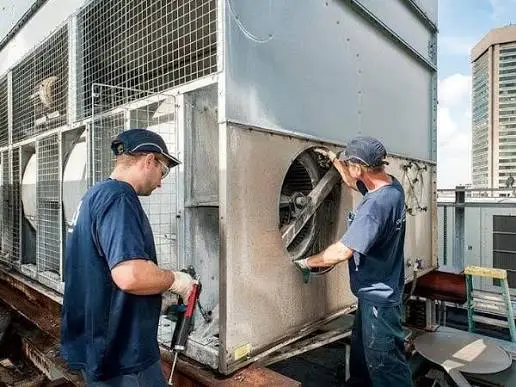
Ask most facilities managers where to look for energy savings and reliability gains, and the cooling tower rarely makes the list. It sits on the roof or beside the plant room, rejecting heat quietly, until the day it does not. A fouled fill pack, a clogged nozzle, or a neglected water treatment program does not announce itself. It shows up as a chiller working harder than it should, rising condenser water temperatures, and a bill nobody can explain.
Cooling towers also carry a health dimension that most other plant does not. Warm, wet, nutrient-rich conditions are exactly what Legionella bacteria need. That is why cooling tower maintenance is as much a safety and compliance task as an efficiency one.
This guide explains how a cooling tower works, what a solid program covers, and a complete cooling tower maintenance checklist organised by frequency and season. It also covers water treatment, flow balancing, Legionella control, warning signs, and the records that keep everything defensible.
What a Cooling Tower Does
A cooling tower is a heat rejection device. Warm water from the chillers or condensers is sprayed over fill material while air moves through the tower. A small portion of the water evaporates, and that evaporation carries heat away from the rest. The cooled water collects in the basin and returns to the plant.
Because the process depends on water, air, and surface contact, anything that disturbs one of those three reduces performance. Scale on the fill, debris in the basin, a broken nozzle, or a failing fan all show up as lost cooling.
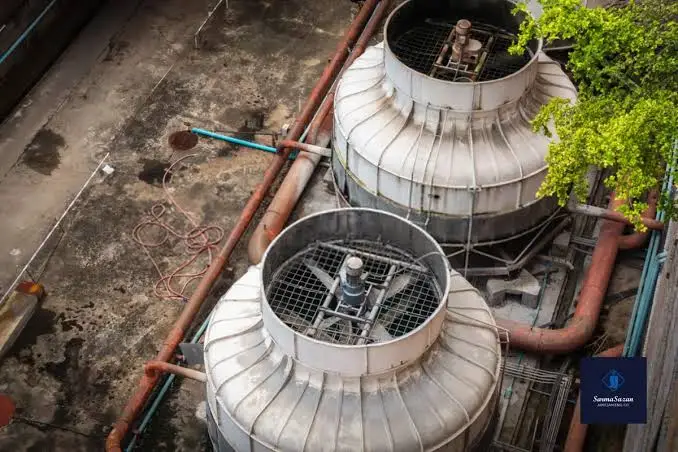
Towers come in several styles, such as cross flow, counter flow, induced draft, and forced draft. Each has slightly different maintenance needs, so always follow the manufacturer’s instructions for your model.
The Main Components You Need to Maintain
| Component | What it does | What goes wrong |
|---|---|---|
| Fan, motor, and drive | Moves air through the tower | Imbalance, cracked blades, worn bearings, belt wear, gearbox leaks, misalignment |
| Fill media | Maximises contact between air and water | Scale, fouling, biological growth, damage, collapse |
| Water distribution system and spray nozzles | Spreads water evenly over the fill | Clogged or broken nozzles, dry spots, poor spray pattern |
| Drift eliminators | Capture water droplets from the exhaust air | Fouling, displacement, damage, which increases water loss and drift |
| Cold water basin and sump | Collects cooled water | Sludge, debris, corrosion, cracks, leaks |
| Strainers and screens | Protect pumps and piping | Blockage and reduced flow |
| Make-up water valve and float | Replaces water lost to evaporation, drift, and blowdown | Sticking valves, wrong level setting |
| Blowdown (bleed-off) system | Removes concentrated dissolved solids | Incorrect setting, failed valve, faulty controller |
| Louvers and inlet screens | Guide airflow and keep splash and debris out | Blockage, damage, algae |
| Water treatment equipment | Doses chemicals and monitors water | Pump failure, sensor drift, empty chemical tanks |
| Pumps and piping | Circulate the water | Seal leaks, cavitation, scale, corroded fittings |
| Casing, structure, ladders, and access | Support and protect the tower | Corrosion, coating failure, loose fixings |
Why Cooling Tower Maintenance Matters
Efficiency. A clean tower rejects heat as designed. Scale, biofilm, and blocked fill force chillers to work harder and use more energy.
Reliability. Fan, motor, and pump failures in summer are costly. Routine checks catch wear before it becomes failure.
Equipment life. Good water treatment and clean surfaces slow corrosion and scale, protecting both the tower and the equipment it serves.
Health and safety. Poorly maintained towers can harbour Legionella. Cleaning, disinfection, and a documented water management plan reduce the risk.
Compliance. Many jurisdictions require water management plans, regular testing, and records. Gaps can lead to enforcement action and liability.
Water use. Leaks, excessive drift, and wrong blowdown settings waste water and chemicals.
Chiller performance. The tower and chiller work as a pair. Our guide on chiller maintenance explains how condenser water conditions affect approach temperatures and compressor load.
Safety and Preparation
Cooling towers combine rotating machinery, electrical equipment, height, wet surfaces, chemicals, and biological hazards.
- Follow the manufacturer’s instructions for your specific tower, and only do work you are trained and authorised to perform.
- Use lockout and tagout on fans, pumps, and chemical feed equipment, and confirm that fans have stopped fully. Fans can turn in the wind.
- Treat basins and enclosed spaces with care. Entry may fall under confined space rules.
- Use fall protection for work at height and safe access routes.
- Wear PPE suited to the task, including eye and skin protection when handling treatment chemicals, and respiratory protection where aerosols or disinfection are involved.
- Handle chemicals correctly, following safety data sheets, and never mix products.
- Control aerosols during cleaning and disinfection, and keep people away from the discharge area.
- Coordinate with your water treatment provider before making changes to chemical programs.
- Plan outages with the building, since taking a tower out of service affects chillers and cooling capacity.
The Cooling Tower Maintenance Checklist by Frequency
Use these frequencies as starting points and adjust them according to manufacturer guidance, local regulations, your water management plan, and operating conditions.
Daily Checks
- Walk the tower and look for visible leaks, unusual noise, or vibration
- Confirm fans, pumps, and motors are running as expected
- Check the basin water level and confirm it is within range
- Check water temperature and pressure gauges, and record readings
- Look at the water flow across the rain zone for evenness
- Check that make-up water and blowdown are operating normally
- Confirm water treatment equipment is running, chemical tanks have supply, and no alarms are active
Weekly Checks
- Test and log water pH, conductivity, and treatment levels. A pH range of roughly 6.5 to 9.0 is often cited, but your water treatment provider sets your targets
- Check and adjust biocide or disinfectant levels as your program specifies
- Measure conductivity and adjust blowdown accordingly
- Inspect water clarity in the basin
- Inspect for leaks at connections, valves, and the distribution system
- Confirm the float valve and make-up feed work freely
- Clean strainers and accessible areas to limit sediment build-up
- Listen for unusual noise or vibration from the fan and motor
- Check the basin for debris and sludge
Monthly Checks
- Lubricate fan shaft bearings to the manufacturer’s specification
- Inspect fan blades for erosion, cracking, imbalance, or corrosion
- Check belt tension and condition on belt-drive systems
- Verify motor amp draw against rated load, and check voltage is within rated limits
- Inspect associated pumps for leaks, cavitation, and abnormal vibration
- Inspect the basin for sludge, debris, cracks, and corrosion
- Review water treatment logs and adjust chemical feed rates as needed
- Check spray nozzles and the distribution pattern
- Check louvers and inlet screens for debris and damage
- Review bacterial testing results as your water management plan requires
Quarterly Checks
- Inspect the exterior, including structure, fan blades, and louvers
- Clean water strainers and filters
- Lubricate fan motor bearings, and check gearbox oil level and condition
- Test water quality more fully, including pH, conductivity, and total dissolved solids
- Inspect drift eliminators for fouling, damage, and correct positioning
- Inspect fill for scale, fouling, and damage
- Calibrate pH and conductivity sensors and verify dosing equipment
Annual Checks
- Carry out a full inspection of mechanical and electrical components
- Inspect the gearbox, if fitted, for oil level, leaks, and gear condition, and replace gearbox oil on the manufacturer’s schedule
- Check and record fan blade pitch angle, and reset if out of specification
- Inspect couplings, sheaves, and belts for wear, and replace as needed
- Verify motor alignment and re-align if required
- Insulation resistance test motors to check for insulation degradation, carried out by a qualified person
- Clean basins and sumps thoroughly
- Inspect fill in depth, and weigh selected fill blocks from lower levels to measure fouling, recording results year on year
- Inspect and clean drift eliminators and the distribution system
- Inspect structure, casing, coatings, handrails, and ladders for corrosion and damage
- Clean the tower and carry out disinfection in line with your water management plan
- Review manufacturer service bulletins and operating instructions for your model
- Confirm the water management plan is current and signed off
- Update maintenance logs and equipment records
Seasonal Checklists
Spring Start-Up Checklist
For towers that shut down in winter, a formal start-up protects equipment and reduces microbial risk.
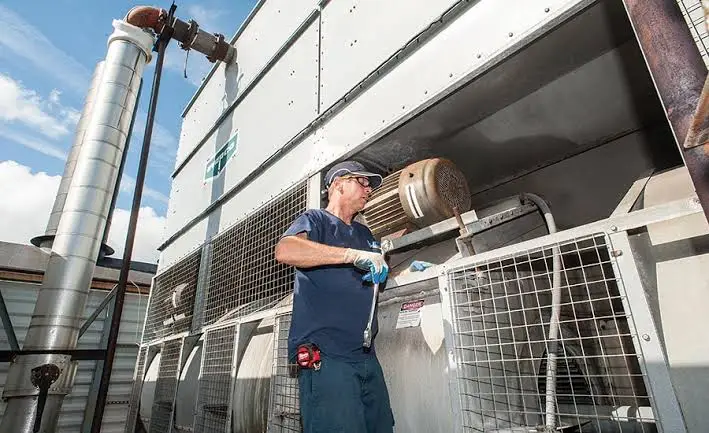
- Remove leaves, dirt, and debris from air inlets
- Flush the cold water basin with strainer screens in place to remove sediment
- Clean and reinstall strainer screens
- Check that the mechanical float valve operates freely
- Clean spray nozzles and check their orientation
- Check that drift eliminators are secure and correctly oriented
- Adjust fan belt tension, and replace belts on the manufacturer’s schedule
- Lubricate fan shaft bearings and sliding motor bases before start-up
- Turn fans and pumps by hand to confirm they rotate freely
- Inspect fan blades for cracks, missing balance weights, or damage
- Look for stagnant water anywhere in the system, including dead legs in piping, and address it before restarting
- Fill the basin to the overflow connection, then set the float valve to the correct operating level
- Check the fan rotates in the correct direction, and measure voltage and current
- Set the bleed valve to the correct flow rate and confirm it operates correctly
- Review the water distribution system and spray pattern
- Inspect sheaves, bushings, fan shafts, and fan hubs for corrosion
- Check fan screens and inlet louvers for debris
- Carry out cleaning and disinfection and start the treatment program as your water management plan requires
Summer Routine Checklist
- Clean the pan strainer and flush the cold water basin
- Confirm the bleed-off valve operates correctly
- Adjust the float valve for the correct operating level
- Inspect the distribution system and spray pattern
- Reassess drift eliminators
- Check fan blades for cracks and vibration
- Inspect sheaves, bushings, shafts, and hubs for corrosion
- Lubricate fan shaft bearings
- Adjust belt tension
- Clean fan screens and inlet louvers
- Increase the frequency of cleaning where pollen, dust, or debris loads are high
- Monitor condenser water temperature closely during heat waves
Fall Shutdown Checklist
- Drain the cold water basin, then flush and clean it with the suction strainer screens in place
- Clean and reinstall suction strainer screens
- Leave the basin drain open if the manufacturer recommends it
- Lubricate fan shaft bearings and motor base adjusting screws
- Close the make-up water valve
- Drain make-up, overflow, and drain piping to prevent freezing
- Inspect the finish of the unit, and clean and refinish as required
- Energise motor space heaters, if fitted
- Record the condition of the tower so the spring start-up starts with known issues
Water Treatment: The Foundation of Cooling Tower Maintenance
Water chemistry drives most of what goes wrong with a tower. Evaporation concentrates dissolved solids, which leads to scale. Aggressive water causes corrosion. Warm, nutrient-rich water grows biofilm. A good water treatment program controls all three.
A typical program includes:
- Scale and corrosion inhibitors matched to your make-up water
- Biocides to control bacteria and algae, with an alternating or monitored approach as your provider recommends
- Bio-dispersants to break up biofilm so biocides can reach it
- Blowdown control based on conductivity, to manage cycles of concentration without wasting water
- Regular testing of pH, conductivity, total dissolved solids, and microbiological counts
- Calibrated sensors and dosing pumps, with alarms for failure or empty chemical supplies
- Records of every test, dose, and adjustment
Treat this as a partnership with a qualified water treatment specialist, because targets depend on your water, metals, and operating conditions.
Legionella Control: The Part You Cannot Skip
Legionnaires’ disease is a serious form of pneumonia, and cooling towers are a recognised source of Legionella risk. The bacteria multiply in warm water, and a commonly cited range is roughly 68°F to 122°F (20°C to 50°C). Biofilm gives them somewhere to live, and the tower’s spray and drift can carry aerosols outside.
Good practice, which varies by jurisdiction, generally includes:
- A written water management plan covering the tower, with responsibilities, control limits, and corrective actions
- Regular cleaning and disinfection, commonly at least twice a year, and after events such as prolonged shutdown or contamination
- Consistent biocide and biofilm control
- Routine monitoring, including microbiological testing at the frequency your plan sets
- Avoiding stagnation, including dead legs and idle sections of pipework
- Effective drift eliminators to limit aerosol release
- Documented responses when results fall outside limits
- Training for staff who work on or around the tower
Requirements differ by country, state, and local authority, so confirm what applies to you and involve your water treatment provider and public health guidance.
Water Flow and Balance: The Overlooked Efficiency Gain
Many towers fail to reach nameplate performance not because of dirt but because of imbalance. Some cells overflow, others are starved, and air velocities vary across the tower. The result is wasted energy and lost capacity, which matters most for facilities where summer production or cooling is limited by tower output.
Good practice includes:
- Checking flow rates to each cell and across the tower at least annually
- Using a suitable flow measurement method, such as a clamp-on ultrasonic flow meter, to avoid opening pipework
- Balancing valves so each cell receives its design flow
- Checking pump and motor amp draw against design
- Verifying air side conditions, fan pitch, and drift eliminator condition
- Comparing results with commissioning data
Flow checks on pumps, chillers, air handlers, and towers each year help confirm the plant is delivering what it was designed to. If you maintain air-side equipment too, our guide on air handling unit maintenance covers the other end of the cooling loop.
Reading the Warning Signs
| Symptom | Likely causes | First checks |
|---|---|---|
| Higher than normal approach temperature | Fouled fill, scale, reduced airflow, poor water distribution | Fill condition, nozzles, fan and motor, flow balance |
| Excessive make-up water use | Leaks, excess drift, malfunctioning blowdown control | Basin and piping, drift eliminators, blowdown settings |
| Vibration or noise | Fan blade damage or imbalance, worn bearings, misaligned coupling, pump cavitation | Blades, bearings, coupling alignment, pump suction |
| Biological growth in the basin | Insufficient biocide, low blowdown, long residence time, stagnation | Dosing, chemical supply, blowdown rate, dead legs |
| Corrosion in the basin or structure | pH drift, treatment gaps, coating failure | Water test results, coatings, inhibitors |
| Uneven water flow across the fill | Clogged or broken nozzles, blocked distribution | Spray pattern, nozzles, strainers |
| Scale on fill or surfaces | High cycles of concentration, inadequate inhibitor | Conductivity, treatment programme, blowdown |
| Excess drift or water carry-over | Damaged or displaced drift eliminators, high flow | Eliminators, flow rate |
| Reduced cooling or rising chiller energy use | Fouling, imbalance, high condenser water temperature | Approach, flow balance, fan operation |
| Motor tripping or high amps | Mechanical drag, misalignment, electrical faults | Bearings, belt, alignment, voltage |
Catching these early keeps a manageable job from becoming a major repair. If degradation becomes severe, compare repair versus replacement using condition records, repair history, and efficiency trends.
Linking Tower Data to Plant Performance
A tower affects the performance of every chiller it serves, so track its numbers alongside the chiller’s:
- Approach temperature (the difference between cold water temperature and the ambient wet bulb temperature)
- Range (the difference between hot and cold water temperatures)
- Condenser water entering temperature at the chiller
- Fan motor amps and run hours
- Make-up water volume and blowdown volume
- Conductivity and cycles of concentration
- Pump flow and pressure
Our guide on real-time asset data in a CMMS explains how to feed selected readings and alarms from controllers into your maintenance system without overload, and our article on OEE for buildings shows how to combine availability, performance, and quality into one view of plant health. If your plant room also includes a boiler, see our guide on the boiler maintenance checklist for the heating side.
Documentation: What to Record and Keep
A tower’s history is as important as its hardware. Keep, for each tower:
- Make, model, serial number, capacity, cell count, and installation date
- Manufacturer’s manuals, operating instructions, and service bulletins
- The written water management plan and review dates
- Daily and weekly logs, with readings and observations
- Water test results, including chemical and microbiological tests
- Chemical usage and dosing records
- Cleaning and disinfection records
- Inspection, repair, and parts replacement history
- Fan pitch, motor, gearbox, and alignment records
- Contractor and laboratory reports
- Photographs of condition before and after major work
- Start-up and shutdown records each season
These records support compliance, warranty claims, budgeting, and replacement planning.
Building a Cooling Tower Maintenance Program
A checklist alone does not maintain anything. To turn it into a program:
- Create an asset record for every tower and its pumps, strainers, and treatment equipment.
- Convert the checklist into scheduled tasks with frequencies, owners, and estimated times.
- Separate in-house and specialist work. Operators can usually handle daily rounds and basic tests. Water treatment, disinfection, microbiological testing, and electrical testing often belong to specialists.
- Book seasonal start-up, cleaning, and shutdown early.
- Define alarm and out-of-limit procedures so operators know what to record and when to escalate.
- Stock common spares, such as nozzles, strainer elements, belts, bearings, and treatment chemicals.
- Track completion and overdue tasks every month.
- Review trends and failures and adjust intervals.
- Train staff to spot warning signs and to follow safety procedures.
Our guide on how to start a preventive maintenance program covers the foundations in more detail.
Why a CMMS Makes Tower Maintenance Easier
Towers are seasonal, regulated, and spread across many small tasks, which makes them easy to under-manage on paper. A CMMS can:
- Schedule weekly, monthly, seasonal, and annual tasks automatically
- Capture water test results and readings against the asset
- Trigger start-up and shutdown checklists at the right time of year
- Store the water management plan, manuals, and lab reports with the tower
- Raise work orders for defects found during rounds
- Flag repeat issues, such as recurring nozzle blockages or dosing failures
- Provide timestamped records for audits and inspections
To see how this works, read why a CMMS is essential for preventive maintenance and how it can streamline preventive maintenance. If you are comparing platforms, FacilityBot’s CMMS software page shows how asset records, schedules, and checklists connect.
Common Cooling Tower Maintenance Mistakes
Treating the tower as set-and-forget. It needs regular attention because water, air, and weather change constantly.
Neglecting water treatment. Scale, corrosion, and biofilm are the main drivers of lost efficiency and risk.
Skipping the water management plan. Documentation is part of Legionella control, not paperwork for its own sake.
Ignoring stagnant sections. Dead legs and idle pipework are classic problem areas.
Overlooking flow balance. Dirty fill gets blamed when uneven flow is the real culprit.
Forgetting nozzles and drift eliminators. They are cheap to maintain and expensive to ignore.
Letting sensors drift. An uncalibrated conductivity or pH probe leads to wrong dosing and wrong blowdown.
Starting up without a checklist. Seasonal restarts are when stagnation and debris cause the most trouble.
Skipping fan and drive checks. Imbalance and bearing wear escalate quickly.
Keeping no records. Without history, repeat problems and compliance gaps stay hidden.
Frequently Asked Questions
What is cooling tower maintenance?
Cooling tower maintenance is the routine inspection, cleaning, testing, and servicing of a cooling tower and its related equipment, including fill, nozzles, drift eliminators, basin, fans, motors, pumps, and water treatment, to keep heat rejection efficient, reliable, and safe.
What should a cooling tower maintenance checklist include?
A cooling tower maintenance checklist should cover water quality testing and treatment, basin and sump cleaning, fan, motor, and drive inspection, fill and drift eliminator checks, spray nozzles and distribution, make-up and blowdown controls, strainers, pumps, structure, seasonal start-up and shutdown tasks, and documentation.
How often should a cooling tower be maintained?
Cooling towers need daily and weekly checks, monthly and quarterly mechanical and water quality tasks, annual inspections, and seasonal start-up and shutdown procedures. Exact frequencies depend on the manufacturer, operating conditions, and local requirements.
How often should a cooling tower be cleaned?
Many guidelines recommend cleaning and disinfection at least twice a year, and also after events such as prolonged shutdown or contamination. Your water management plan and local regulations set the requirement for your site.
Why is water treatment so important for cooling towers?
Water treatment prevents scale, corrosion, and biological growth, including Legionella. Without it, efficiency falls, equipment degrades faster, and health risks rise.
How can cooling tower maintenance improve energy efficiency?
Clean fill, balanced flow, working nozzles, and healthy fans let the tower reject heat as designed, which lowers condenser water temperatures and reduces the load on chillers and pumps.
What are the signs that a cooling tower needs maintenance?
Common signs include a rising approach temperature, unusual noise or vibration, uneven water flow, visible scale or corrosion, biological growth, leaks, high make-up water use, and rising chiller energy consumption.
How do I prevent Legionella in a cooling tower?
Follow a written water management plan, maintain biocide and biofilm control, clean and disinfect on schedule, avoid stagnant water, keep drift eliminators in good condition, test regularly, and document corrective actions. Requirements vary by jurisdiction.
What should I do when starting a cooling tower after winter?
Clean debris, flush the basin, clean strainers, check the float valve, clean nozzles, inspect drift eliminators and fans, lubricate bearings, check for stagnant water, refill and set levels, confirm fan rotation, set the bleed valve, and carry out cleaning and disinfection as your plan requires.
Can in-house staff maintain a cooling tower?
Trained staff can usually handle rounds, basic water tests, strainer cleaning, and visual inspections. Water treatment programs, disinfection, microbiological testing, and electrical testing often involve specialists, and all work should follow lockout and tagout and safe access rules.
How does a CMMS help with cooling tower maintenance?
A CMMS schedules recurring and seasonal tasks, records readings and test results, stores plans and reports, turns defects into work orders, and builds an auditable maintenance history.
Simplify Cooling Tower and Facility Management With FacilityBot
A cooling tower program only works when every test is logged, every task is signed off, and every season starts and ends with a checklist. FacilityBot helps facilities teams make that routine. Our facilities management software holds each tower’s asset record, checklists, water test results, schedules, and service history in one place, so compliance does not depend on a binder. As a facility management solution built for lean teams, it connects preventive tasks, contractor and water treatment visits, and reactive repairs to the equipment they affect. Because it is cloud based CMMS software, technicians can work through the cooling tower maintenance checklist on a phone, record readings, attach photos, and raise a work order for a blocked nozzle before leaving the roof. And with built-in fault reporting software, staff and occupants can report a warm zone, a noisy fan, or a leak the moment they notice it, so early warning signs reach your team before they become shutdowns. Book a demo to see how FacilityBot can support your cooling tower maintenance.
