
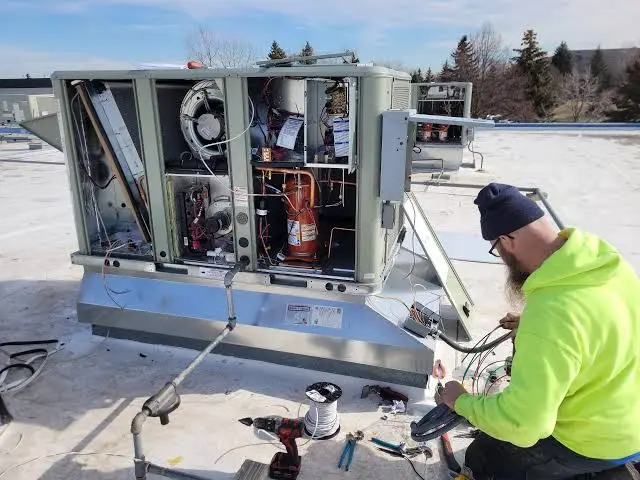
Rooftop units have one built-in disadvantage: they are out of sight. A technician cannot hear a failing bearing from the ground floor, and a facilities manager rarely notices a clogged filter until a tenant complains about a warm office. By then the unit has usually been struggling for weeks.
That is why rooftop unit maintenance works best as a scheduled routine rather than a reaction. RTUs sit in the weather, run long hours, and hold nearly everything an HVAC system needs in one box: fans, coils, compressors, controls, dampers, and often gas heating. Each of those parts has its own way of wearing out.
This guide explains what an RTU is made of, how often each part needs attention, and a complete RTU maintenance checklist you can adapt to your own units. It also covers safety, common faults, spare parts, seasonal timing, and how to keep records that make the work provable.
What a Rooftop Unit Does
A rooftop unit is a packaged HVAC system installed on a building’s roof. It is self-contained, meaning the equipment needed to condition air sits inside one cabinet. The unit draws in return air and outside air, filters it, heats or cools it, and pushes it through ductwork to the spaces below. RTUs are common in offices, retail stores, supermarkets, schools, and other commercial buildings.
A typical RTU contains:
| Component | What it does | What goes wrong |
|---|---|---|
| Air filters | Remove dust and particles before air enters the system | Clogging, bypass around the frame, wrong filter grade |
| Dampers and economizer | Control outside air, return air, and exhaust, and enable free cooling | Stuck blades, failed actuators, broken linkages, leaking seals |
| Evaporator coil | Cools and dehumidifies the air | Fouling, freezing, drain problems |
| Condenser coil | Rejects heat to the outdoor air | Dirt, debris, bent fins, corrosion |
| Compressor(s) | Circulate refrigerant | Electrical faults, wear, low charge, overheating |
| Supply fan, blower motor, and drive | Move air through the unit and ductwork | Belt wear, bearing failure, imbalance, motor faults |
| Condenser fan motors | Move air across the condenser | Bearing wear, capacitor failure, blade damage |
| Heating section (gas or electric) | Provides heat | Failed igniters, flame sensors, pressure switches, heat exchanger problems |
| Heat recovery or heat exchanger sections | Pre-condition incoming air using exhaust air | Fouling, leakage |
| Electrical controls and safeties | Start, stop, and protect the unit | Loose connections, failed contactors, sensor drift |
| Condensate drain | Removes moisture | Blockage, overflow, algae |
| Cabinet, curb, and roof seals | Keep weather out | Corrosion, loose panels, leaks |
If you maintain indoor air handlers as well, our guide on air handling unit maintenance covers many of the same air-side tasks. RTUs add refrigeration, combustion, and weather exposure to the mix.
Why Rooftop Unit Maintenance Matters
Weather exposure. Wind, dust, rain, snow, and sun all age rooftop equipment faster than indoor plant. Leaves and debris collect on coils, and moisture finds its way into panels.
Energy use. Dirty filters and coils force fans and compressors to work harder for the same result.
Comfort and complaints. Many “too hot” and “too cold” calls trace back to filters, dampers, or controls on an RTU.
Equipment life. Lubrication, clean coils, tight electrical connections, and correct belt tension reduce wear on expensive components.
Fewer emergency calls. RTUs tend to fail on the hottest and coldest days, exactly when demand is highest. Planned checks catch faults early.
Indoor air quality. Filters, drain pans, and damper settings all affect what occupants breathe.
Safety. Gas heating, high voltage, and refrigerant all need regular attention from qualified people.
Safety First: Working on a Roof
Rooftop work combines height, weather, electrical hazards, and rotating machinery.
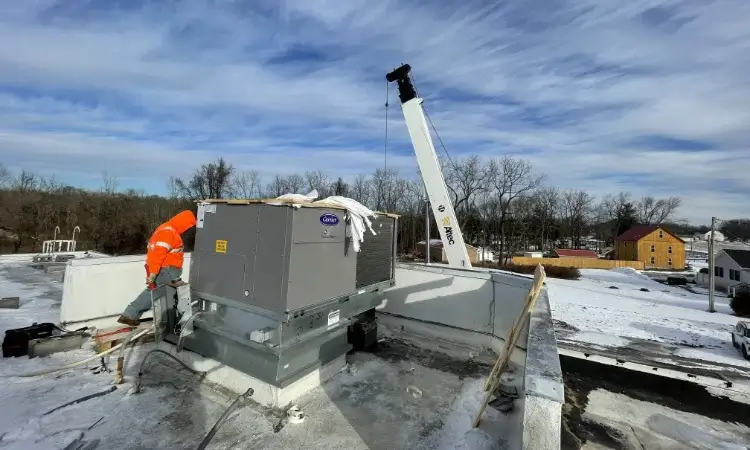
- Get permission and follow site procedures before accessing the roof or equipment.
- Use safe access. Use fixed ladders, guardrails, or fall protection where required, and stay clear of roof edges and skylights.
- Wear appropriate PPE, such as a hard hat, safety glasses, gloves, and safety boots, and add hearing and respiratory protection when needed.
- Lock out and tag out all electrical supplies before opening panels or touching fans, belts, or components.
- Wait before touching electrical parts. Capacitors can hold a charge even after power is switched off, so follow the manufacturer’s discharge and waiting guidance.
- Use the right tools for each task, and avoid improvising.
- Respect the weather. Avoid roof work in lightning, high winds, ice, or extreme heat.
- Protect the roof. Use walkway pads where needed, and avoid dragging equipment across the membrane.
- Leave refrigerant, gas, and high-voltage work to qualified technicians.
- Tell the building. Let occupants and the BMS operator know when a unit will be offline.
The Complete RTU Maintenance Checklist
The frequencies below are typical starting points. Always follow the manufacturer’s manual for your exact unit, and adjust for local conditions such as dust, pollen, coastal air, operating hours, and building criticality.
1. Filters and Filter Section
Monthly or at each visit
- Check filters for loading, damage, and moisture
- Confirm filters are seated properly with no gaps for bypass
Quarterly, or as loading dictates
- Replace disposable filters, and clean washable ones only if the manufacturer allows it
- Check the airflow arrow on each filter and install it in the direction of airflow
- Make sure the filter is completely dry before reinstalling a washed filter
- Use the grade specified for the unit, and avoid filters so restrictive that they starve the fan
Most RTUs use disposable filters, and the number depends on the size of the unit. Clogged filters make the whole unit work harder, like breathing through a dirty mask.
2. Dampers and Economizer
Quarterly or semi-annually
- Check that dampers move smoothly through their full range
- Inspect blades for damage, dust build-up, and gaps when closed
- Inspect damper linkages and seals
- Check damper motors and actuators and their wiring to the controls
- Verify the damper closes completely and opens in the correct direction
- Confirm minimum outside air settings are correct
- Clear debris from intakes, screens, and louvres
Annually
- Inspect the economizer operation, including sensors and control logic
- Lubricate linkages where the manufacturer specifies
Dampers can be manual or modulating. Common failures include jammed linkages, damaged blades, worn gaskets, and automatic dampers operating in reverse.
3. Coils
Quarterly
- Inspect condenser and evaporator coils for dirt, debris, bent fins, and corrosion
Annually, or more often in dusty or leafy locations
- Clean both the condenser and evaporator coils using an approved coil cleaner or low-pressure method
- Clean in the opposite direction to airflow where possible
- Straighten bent fins with a fin comb
- Avoid high-pressure water that can flatten fins
- Protect electrical components from water during cleaning
4. Fans, Motors, and Belts
Monthly or at each visit
- Listen for unusual noise or vibration
- Inspect belts for cracking, fraying, glazing, and wear
- Check belt tension
Semi-annually
- Check fan sheaves for alignment and wear
- Check fan bearing supports and lubricate per the manufacturer
- Examine motor supports and hold-down bolts
- Measure volts and amps on condenser fan motors and blower motors, and compare with nameplate values
- Inspect fan blades for cracks, missing balance weights, and corrosion
- Replace belts in matched sets, and re-tension after running in
- Turn fans by hand after long idle periods to confirm they spin freely
5. Electrical Components and Controls
Semi-annually
- Check the power supply for correct voltage and phase balance
- Inspect and tighten electrical connections with power isolated
- Inspect starters, contactors, and contact surfaces for pitting and wear
- Check capacitors for bulging or leakage
- Inspect safety controls and verify they operate
- Check all operating controls and thermostat or controller settings
- Confirm sensors read correctly, and calibrate where needed
- Look for signs of overheating, moisture, rodents, or insect nests in panels
6. Refrigeration Circuit
Semi-annually, by a qualified technician
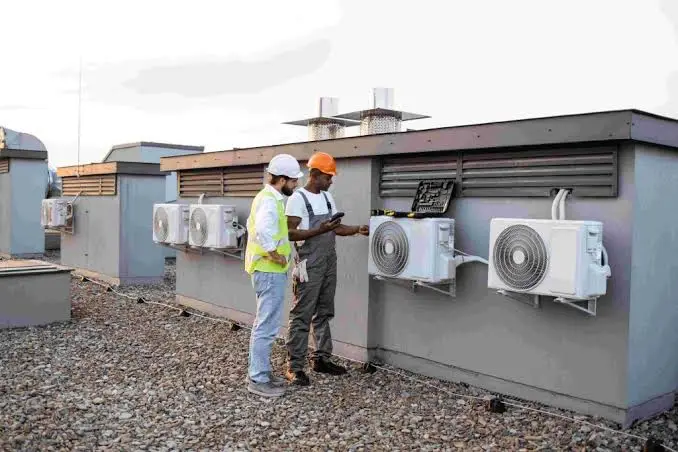
- Check the refrigerant charge, and look at sight glasses where fitted
- Check superheat and subcooling
- Check hot gas bypass controls and head pressure controls
- Check compressor efficiency and operating pressures
- Inspect capillary tubes and refrigerant piping for chafing
- Look for oil and refrigerant leaks at joints, valves, and coils
- Record and compare readings with previous visits
Never add refrigerant without finding and fixing the cause of the loss, and log any refrigerant added or recovered for compliance.
7. Heating Section
Before heating season, and semi-annually
- Inspect gas-fired heat exchangers for cracks, corrosion, and soot
- Check igniters and flame sensors, and clean or replace as needed
- Check pressure switches and limit controls
- Check the burner for a stable, correct flame
- Check flue and combustion air passages for blockage
- Verify safeties, such as high limit and rollout switches, operate correctly
- Check gas valve operation and look for leaks, with gas work done by qualified people
For electric heat, inspect elements, contactors, and safeties.
8. Condensate Drainage
Quarterly during cooling season
- Inspect the drain pan for standing water, algae, and debris
- Clear drain lines and traps
- Confirm condensate flows freely and does not overflow
- Check float switches and overflow protection, where fitted
- Make sure drain lines are protected from freezing where required
9. Cabinet, Curb, and Roof Condition
Quarterly
- Check cabinet panels, latches, and gaskets for leaks and looseness
- Inspect internal insulation for damage and moisture
- Look for rust, corrosion, and failed coatings, and treat early
- Inspect the roof curb, flashing, and sealant around the unit
- Check that the unit is level and its mounting is secure
- Clear debris, leaves, and standing water from around the unit
- Check clearances to confirm airflow is not blocked
10. Ductwork and Air Distribution
Annually, or as problems suggest
- Inspect visible supply and return ductwork for dents, leaks, clogs, corrosion, and loose joints
- Check duct insulation and seals
- Check grilles, diffusers, and registers for dust build-up and blocked airflow
- Check airflow at representative grilles, and look for leakage when readings drop
- Inspect inside ducts with a flashlight or inspection camera if you suspect contamination or mould, especially after a long shutdown
11. Performance Checks and Records
At every scheduled visit
- Record supply and return air temperatures and the temperature split across the coil
- Record motor amps, voltages, and operating pressures
- Note filter, belt, and coil condition
- Photograph anything unusual
- Record parts used and time taken
- Raise work orders for defects found
RTU Maintenance Frequency at a Glance
| Frequency | Typical RTU tasks |
|---|---|
| Monthly | Visual check, filter inspection, belt check, noise and vibration check |
| Quarterly | Filter replacement, drain pan and line cleaning, damper operation, cabinet and curb inspection, coil inspection |
| Semi-annual | Electrical tightening and testing, motor and fan checks, refrigeration performance checks, safety controls, damper linkages, heating section check |
| Annual | Coil cleaning, economizer inspection, duct and grille inspection, full performance review |
| Seasonal | Cooling readiness before summer, heating readiness before winter, start-up after long shutdowns |
| After storms | Check for debris, panel damage, water ingress, and loosened fixings |
Many facilities schedule a full service at least twice a year, with lighter checks in between. High-use, dusty, or critical units may need more.
Seasonal Readiness
Before summer
- Clean condenser coils, and clear leaves and debris
- Replace filters and check drain lines
- Test cooling operation, including compressor and condenser fan amps
- Verify refrigerant performance indicators and controls
- Check damper and economizer operation
Before winter
- Inspect heat exchangers, igniters, flame sensors, and pressure switches
- Check flue and combustion air paths
- Test safeties and limit controls
- Check freeze protection and drain line protection
- Confirm dampers close fully to limit cold air infiltration
After long idle periods
- Turn fans by hand to confirm they move freely
- Check for nests, debris, and moisture
- Inspect for mould or stagnant water in drain pans
- Verify the unit starts and runs normally before relying on it
Common RTU Problems and What to Check First
| Symptom | Likely causes | First checks |
|---|---|---|
| Weak cooling or heating | Dirty filters or coils, low refrigerant, damper faults, failed heating components | Filter condition, coil cleanliness, temperature split, damper position |
| Unit does not start | Power supply, tripped breaker, failed contactor, control fault, safety lockout | Disconnect, breaker, controller alarms, safety switches |
| Short cycling | Oversizing, controls, low airflow, refrigerant issues | Filters, thermostat or controller settings, airflow |
| Noise or vibration | Worn bearings, loose belt, imbalance, loose panels | Belt, bearings, fan wheel, mounting |
| Water leaking or overflow | Blocked condensate drain, damaged pan | Drain line, trap, pan condition |
| Frozen evaporator coil | Low airflow, low charge, dirty filters | Filters, blower operation, refrigerant checks |
| High energy use | Dirty coils, leaking dampers, running outside schedule | Coil condition, damper seals, schedules |
| Damper not moving or stuck | Failed actuator, jammed linkage, wiring problem | Actuator, linkage, control signal |
| Heating fails to ignite | Igniter, flame sensor, pressure switch, gas supply | Ignition sequence, sensors, switches |
| Poor air quality complaints | Wet pans, dirty filters, mould, wrong outside air settings | Drain pan, filters, ducts, damper settings |
| Unit slow to start after long idle | Dried seals, seized bearings, weak capacitors | Fan rotation, capacitors, lubrication |
When equipment raises alarms or trouble signals, record them rather than only resetting them. Our guide on chiller fault codes shows how to turn alarm messages into useful maintenance records, and the same approach applies to RTU controllers.
Spare Parts Worth Keeping
A small stock keeps a short repair from becoming a long outage. Common items for RTUs include:
- Filters in every size and grade used
- Belts, in matched sets for each drive
- Flame sensors and igniters
- Pressure switches
- Capacitors, contactors, relays, and fuses
- Thermostat or sensor batteries
- Coil cleaner and drain treatments
- Lubricants specified by the manufacturer
For larger portfolios with many similar units, consider higher-value spares shared across equipment, such as motors, bearings, control boards, and actuators.
Use Live Data to Spot Problems Between Visits
Rooftop equipment is hard to listen to, so data matters. Building management systems and monitoring devices can trend supply temperature, airflow, run hours, filter pressure drop, and alarms. Rising motor amps, a widening temperature split, or a unit running outside its schedule are early warning signs. Feeding selected signals into your maintenance system lets thresholds raise work orders automatically. Our guide on real-time asset data in a CMMS explains how to choose what to send and avoid alarm overload, and our article on OEE for buildings shows how to track availability and performance over time.
Documentation: Prove the Work Was Done
For each RTU, keep:
- Make, model, serial number, capacity, refrigerant type, fuel type, location, and areas served
- Manufacturer’s manuals, wiring diagrams, and sequence of operation
- Filter sizes and grades, belt part numbers, and lubricant specifications
- A dated record of every inspection, cleaning, repair, and part replaced
- Operating readings over time, such as amps, pressures, and temperature split
- Refrigerant logs showing amounts added or recovered
- Photos of condition before and after major work
- Contractor reports and certificates
This history supports warranty claims, budget requests, replacement planning, and audits.
Turning the Checklist Into a Program
A list does not maintain anything by itself. To make it work:
- Create an asset record for every RTU, including location, areas served, and criticality.
- Convert the checklist into scheduled tasks with frequencies, owners, and estimated times.
- Separate in-house and specialist work. Staff can usually handle filters, visual checks, drains, and readings. Refrigerant, gas, and high-voltage work belongs to qualified technicians.
- Spread the workload so every unit is not scheduled for the same week.
- Plan around the seasons, with cooling checks before summer and heating checks before winter.
- Prioritise critical units, such as those serving sensitive spaces or customer-facing areas.
- Turn findings into work orders so a defect noted on a checklist is tracked to repair.
- Review failures and trends, and adjust intervals for units that keep giving trouble.
- Track completion and chase overdue tasks every month.
Our guide on how to start a preventive maintenance program covers the foundations in more detail. If you manage other plant, our guides on boiler maintenance checklists, chiller maintenance, and cooling tower maintenance cover heating and cooling equipment elsewhere on site.
Paper vs. Digital Checklists
Paper checklists are easy to start and hard to sustain. Sheets get lost or wet on the roof, handwriting fades, and nobody can see which units are overdue. Digital checklists let technicians work from a phone or tablet, record readings, attach photos, and raise a work order for a worn belt before leaving the unit. They also show at a glance which RTUs are overdue and which keep failing.
For more on how this works, read why a CMMS is essential for preventive maintenance and how it can streamline preventive maintenance. If you are comparing platforms, FacilityBot’s CMMS software page shows how asset records, schedules, and checklists connect.
Common RTU Maintenance Mistakes
Replacing filters on the calendar only. Loading depends on dust, season, and runtime, so inspect as well.
Forgetting the airflow arrow. Filters installed backwards perform poorly and can collapse.
Cleaning coils with high pressure. It flattens fins and reduces airflow.
Ignoring drain lines. Blocked condensate leads to overflow and ceiling damage.
Overlooking dampers and economizers. Stuck or leaking dampers waste energy without any obvious alarm.
Skipping electrical tightening. Loose connections cause heating, arcing, and unexpected failures.
Replacing a single belt in a matched set. Replace belts together and re-tension after running in.
Topping up refrigerant without finding the leak. It is a diagnostic mistake and may breach regulations.
Working without lockout. Always isolate power, and allow stored energy to dissipate.
Treating every unit the same. Critical, heavily used, or exposed units need more attention.
Keeping no records. Without history, repeat faults and compliance gaps stay hidden.
Frequently Asked Questions
What is rooftop unit maintenance?
Rooftop unit maintenance is the routine inspection, cleaning, lubrication, adjustment, and testing of a packaged rooftop HVAC unit, including filters, coils, fans, belts, dampers, electrical controls, refrigeration, heating, and drainage, to keep it efficient and reliable.
How often should a rooftop unit be serviced?
Many facilities schedule a full service at least twice a year, with monthly or quarterly checks in between. The right frequency depends on the manufacturer’s guidance, operating hours, local conditions, and how critical the unit is.
What should an RTU maintenance checklist include?
An RTU maintenance checklist should cover filters, dampers and economizer, evaporator and condenser coils, fans, motors, and belts, electrical connections and controls, refrigeration performance, the heating section, condensate drainage, cabinet and curb condition, ductwork and grilles, and performance readings.
How often should RTU filters be changed?
Many facilities replace filters quarterly, but dusty, high-use, or high-pollen environments may need more frequent changes. Inspect monthly and change based on condition and pressure drop, not only the calendar.
How often should RTU coils be cleaned?
Coils are commonly cleaned at least once a year, and more often in dusty or leafy locations. Use an approved cleaner and low-pressure method to avoid bending fins.
What are the most common RTU problems?
Dirty filters and coils, failed dampers and actuators, belt and bearing wear, electrical component failures, refrigerant leaks, blocked condensate drains, and heating component faults such as igniters, flame sensors, and pressure switches.
Can in-house staff maintain RTUs?
Trained staff can usually handle visual checks, filter changes, drain cleaning, and basic readings. Refrigerant handling, gas work, and electrical testing should be done by qualified technicians, and all work should follow lockout and roof safety procedures.
What spare parts should I keep for RTUs?
Common spares include filters, matched belt sets, flame sensors, igniters, pressure switches, capacitors, contactors, fuses, and cleaning supplies. Larger sites may also hold motors, bearings, and actuators.
Why is rooftop maintenance harder than indoor HVAC maintenance?
Units are exposed to weather, accessed through ladders and roof hatches, and out of earshot, so early warning signs are easy to miss. A fixed schedule and good records matter more for that reason.
How does a CMMS help with RTU maintenance?
A CMMS schedules recurring and seasonal tasks, records readings and photos, stores manuals and history, turns defects into work orders, and shows which units are overdue or repeatedly failing.
Simplify RTU and Facility Management With FacilityBot
An RTU checklist only works if it is scheduled, completed on the roof, and recorded afterwards. FacilityBot helps facilities teams make that routine. Our facilities management software holds each unit’s asset record, checklist, schedule, and service history in one place, so nothing depends on memory or a damp clipboard. As a facility management solution built for lean teams, it connects preventive tasks, contractor visits, and reactive repairs to the equipment they relate to. Because it is cloud based CMMS software, technicians can work through the RTU maintenance checklist on a phone, log amp readings, attach photos, and raise a work order for a worn belt before climbing down. And with built-in fault reporting software, staff and occupants can report a warm room, a noisy unit, or a dripping ceiling the moment they notice it, so problems reach your team before they become breakdowns. Book a demo to see how FacilityBot can support your rooftop unit maintenance.
