
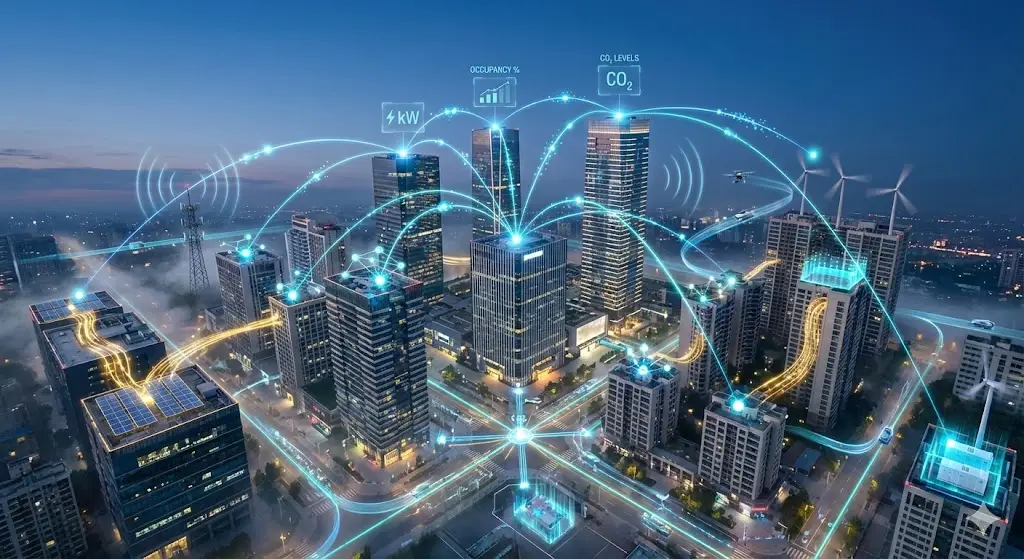
Walk into an office today and you might not notice it, but the lights dim automatically when a meeting room empties out, the HVAC system quietly recalibrates based on how many people are actually in the building, and a facilities manager somewhere is looking at a dashboard that flagged a failing chiller three weeks before it would have failed on its own. This is a smart building at work, and it represents one of the fastest-growing shifts in how commercial real estate is designed, operated, and maintained.
If you manage facilities, oversee operations, or are simply trying to understand where the built environment is headed, this guide breaks down what a smart building actually is, how smart building technology works under the hood, and why the shift matters for cost, comfort, and sustainability.
What Is a Smart Building?
A smart building, sometimes called an intelligent building, is a structure that uses connected digital technology to automate tasks that were traditionally handled manually. Instead of a facilities team manually adjusting thermostats, walking floors to check on equipment, or waiting for a system to break down before fixing it, a smart building relies on networks of sensors, software platforms, and increasingly, artificial intelligence to do much of that work continuously and in real time.

The term started appearing in the 2000s as networked infrastructure began reshaping commercial design. Since then, smart building technology has evolved well beyond simple automation. Modern systems now lean heavily on machine learning to recognize patterns in building data and make predictions, whether that’s forecasting energy demand, catching a maintenance issue before it escalates, or adjusting comfort settings before an occupant even notices something is off.
The category is growing fast. Market analysts project the global smart building sector to grow by tens of billions of dollars over the next five years, with a compound annual growth rate above 11%, a clear signal that this is no longer a niche investment for flagship properties but a mainstream operational strategy.
How Smart Building Technology Actually Works
Smart building technology is built on a stack of interconnected layers, each doing a specific job:
- Physical layer: The building itself, its walls, HVAC equipment, doors, and electrical systems, many of which are now instrumented with sensors.
- Network layer: The wired and wireless infrastructure, from Ethernet to Wi-Fi, that moves data between devices and software in real time.
- Data layer: Where sensor data is collected, processed, and stored, often using a mix of edge computing for speed and cloud platforms for long-term analysis.
- Application layer: Building management systems (BMS) and building automation systems (BAS) that turn raw data into usable functions like predictive maintenance and automated comfort control.
- User interface layer: The dashboards and apps that let facilities teams monitor conditions and decide what to automate.
A few components show up across almost every smart building deployment:
- IoT devices and sensors that track temperature, occupancy, air quality, humidity, and energy use
- Building management and automation systems that centralize control of lighting, HVAC, and security
- Machine learning algorithms that analyze trends and support decisions around energy, occupancy, and security
- Cybersecurity tools like firewalls and intrusion detection, since a building that runs on networked data is also a target for attackers
In practice, this means a smart building can notice that a conference room is rarely used on Friday afternoons and automatically scale back heating and lighting during that window, or flag that a rooftop unit’s vibration pattern has shifted in a way that historically precedes a failure, giving a maintenance team days or weeks of lead time instead of an emergency callout.
Why Smart Buildings Matter
The appeal of smart building technology isn’t really about novelty. It comes down to a handful of very concrete outcomes that facility teams and building owners care about.

Energy efficiency. Buildings account for a significant share of global energy consumption, and smart systems directly target the biggest source of waste: heating, cooling, and lighting spaces that aren’t actually being used. Occupancy-based automation alone can meaningfully cut energy spend.
Lower operating costs. When lighting and HVAC scale down automatically in unoccupied areas, and when historical data is used to plan energy usage around time of day and season, operational costs drop without anyone having to manually intervene.
Predictive maintenance. Instead of the traditional run-to-failure model, real-time monitoring lets teams catch equipment issues while they’re still minor. That extends asset life, reduces emergency repair costs, and prevents the kind of downtime that disrupts an entire building.
Occupant comfort. Personalized temperature, lighting, and air quality settings, often tied to occupancy and even circadian rhythm, create a noticeably better experience for the people using the space every day.
Stronger security. Integrated access control, surveillance, and AI-based anomaly detection give facilities teams a much faster way to spot and respond to threats.
Sustainability progress. Smart buildings give owners the real-time visibility needed to track emissions and energy usage against sustainability targets, and to make informed decisions about retrofitting older assets rather than replacing them.
Some of the most cited examples make the case well. The Empire State Building, despite being over a century old, was retrofitted with smart sensors and a modern building management system and has consistently cut energy costs by millions of dollars a year. The Edge in Amsterdam earned one of the highest sustainability ratings ever recorded by connecting its systems to a smartphone app that adjusts each room to an occupant’s preferences the moment they arrive. These aren’t experimental showcases anymore, they’re proof that smart building technology pays for itself.
Where Smart Building Technology Is Headed
Three trends are shaping the next phase of adoption. AI systems are moving from single-purpose automation into more autonomous, multi-task platforms that need less human oversight. Buildings are starting to connect beyond their own four walls into shared citywide networks and digital infrastructure. And as buildings lean further into connectivity, cybersecurity is becoming just as important a design consideration as HVAC or lighting.
For facility and operations teams, the practical takeaway is this: the technology that used to separate a handful of flagship “smart” properties from everything else is becoming table stakes across offices, hospitals, schools, and industrial facilities alike.
How FacilityBot Supports Smart Building Operations
Turning smart building data into action requires more than sensors and dashboards, it requires a system that can actually manage the day-to-day work those insights generate. FacilityBot is a cloud-based CMMS software platform built to help facilities teams do exactly that. Its built-in fault reporting system lets occupants and technicians flag issues the moment they’re detected, whether that’s a sensor alert or a hands-on inspection, so problems get routed to the right team without delay. As a maintenance management software solution, FacilityBot centralizes work orders, preventive maintenance schedules, and asset histories in one place, helping teams move from reactive firefighting to the kind of predictive, data-driven maintenance that smart buildings are designed to enable. For organizations investing in smart building technology, pairing that infrastructure with the right CMMS software is what actually turns real-time data into lower costs, longer asset life, and a better experience for everyone in the building.
