
Unplanned downtime is expensive. The average manufacturer loses roughly 800 hours a year to it, and that number climbs fast once aging equipment, tight budgets, and a shrinking pool of skilled technicians enter the picture. Two maintenance strategies exist specifically to bring that number down: preventive maintenance and predictive maintenance.
Both are proactive. Both aim to catch problems before they become breakdowns. But predictive maintenance vs preventive maintenance is not simply a matter of preference. Whether you call it preventive vs predictive maintenance, predictive vs preventive maintenance, or preventive maintenance vs predictive, you’re asking the same underlying question, and the two approaches work on completely different logic, cost different amounts to run, and suit different kinds of assets. Get the choice wrong and you either spend money maintaining equipment that didn’t need it, or miss the warning signs on equipment that did.
This guide breaks down what preventive and predictive maintenance actually mean, how they compare in practice, and how to decide which one, or which combination, is right for your facility.
What Is Preventive Maintenance?
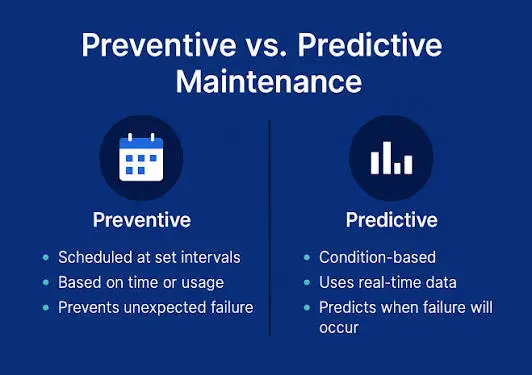
Preventive maintenance, sometimes spelled preventative maintenance, is maintenance carried out on a fixed schedule, regardless of whether the equipment is currently showing signs of a problem. Think routine upkeep: an oil change every few thousand miles, an HVAC filter swap every quarter, a safety inspection every month. The concept has been around since roughly 1900 and has been standard industrial practice since the 1950s.
Preventive maintenance generally falls into three categories:
- Usage-based schedules, which trigger maintenance after a set amount of wear, like servicing a machine every 500 operating hours or rotating tires every 50,000 miles
- Calendar or time-based schedules, which trigger maintenance at fixed intervals regardless of usage, like an annual furnace inspection
- Condition-based schedules, which adjust timing around general wear and degradation patterns, without full real-time monitoring
In every case, the schedule is set in advance using historical averages and manufacturer guidance, not live data from the asset itself. Common examples include lubricating conveyor motors, replacing HVAC filters on a set calendar, inspecting fire extinguishers monthly or quarterly, and swapping worn belts before they fail.
What Is Predictive Maintenance?
Predictive maintenance flips the trigger. Instead of a calendar, it relies on the real-time condition of the equipment itself. Sensors continuously monitor signals like vibration, temperature, sound, and lubricant condition, feed that data into maintenance software, and flag a problem as soon as it starts developing rather than on a fixed schedule.
The most common predictive maintenance techniques include:
- Vibration analysis, which picks up abnormal vibration patterns that often signal misalignment or bearing wear well before failure
- Oil analysis, which checks lubricant condition to catch contamination or component wear early
- Thermal or infrared imaging, which spots overheating in electrical panels or motors, often caused by a loose connection or blocked airflow
- Ultrasonic testing, which detects compressed air, steam, or gas leaks that are inaudible to the human ear
- Motor circuit analysis, which checks a motor’s electrical health for issues like insulation breakdown or winding faults
Predictive maintenance was pioneered in the oil and gas industry, where an unplanned failure carries environmental risk on top of downtime. It has since spread into manufacturing, shipping, power generation, and transportation, essentially anywhere a breakdown is costly enough to justify the investment in sensors and analysis.
Preventive vs Predictive Maintenance: Key Differences
The clearest way to see preventive vs. predictive maintenance is side by side.
| Feature | Preventive Maintenance | Predictive Maintenance |
|---|---|---|
| Trigger | Fixed schedule (time or usage) | Real-time asset condition |
| Data used | Historical averages, manufacturer guidance | Live sensor data (vibration, temperature, oil, etc.) |
| Downtime | Planned, but sometimes unnecessary | Minimal, targeted only at real issues |
| Starting cost | Lower, minimal equipment needed | Higher, requires sensors and analytics tools |
| Best suited for | Low-criticality, predictable-failure assets | High-value, critical, or unpredictable-failure assets |
| Risk of over-maintaining | Higher, since work happens whether needed or not | Lower, since maintenance is condition-triggered |
In short, the comparison comes down to whether you’re maintaining on a schedule or maintaining on evidence. Preventive maintenance is simpler to start and doesn’t require monitoring equipment. Predictive maintenance costs more upfront but tends to catch problems earlier and waste less effort on equipment that didn’t actually need attention yet.
Benefits and Challenges of Each Approach
Preventive Maintenance: Pros and Cons
Benefits:
- Increases equipment lifespan through consistent upkeep
- Reduces unplanned downtime by catching wear before failure
- Is straightforward to run, even with less experienced staff
- Improves workplace safety by keeping equipment in known condition
Challenges:
- Can lead to unnecessary work on equipment that didn’t need it yet
- Still requires planned downtime to carry out
- Relies on averages, so a problem can occasionally still be caught too late
Predictive Maintenance: Pros and Cons
Benefits:
- Catches real issues early, based on actual asset condition
- Shortens downtime since maintenance is targeted rather than routine
- Improves parts and inventory efficiency, since components are replaced when needed rather than on a guess
- Feeds data into broader tools like digital twins for scenario planning
Challenges:
- Requires a larger upfront investment in sensors and software
- Needs data-ready infrastructure and staff trained to interpret it
- Involves a cultural shift, moving teams from fixed schedules to flexible, condition-based planning
Predictive vs Preventive Maintenance by the Numbers
The data makes a strong case for predictive maintenance wherever it’s affordable to implement. Research from the McKinsey Global Institute estimates that wider adoption of predictive maintenance could unlock between $240 billion and $627 billion in cost savings across the manufacturing industry. Facilities that shift to predictive strategies have reported downtime reductions in the 35 to 50 percent range, along with a 20 to 40 percent increase in asset lifespan.
That doesn’t make predictive maintenance the automatic right choice for every asset, though. It requires real investment, and a shrinking skilled workforce, the field service industry alone is projected to face a shortfall of roughly 2 million workers, makes the transition harder for some organizations to staff. For lower-value, non-critical equipment, a well-run preventive maintenance program often delivers most of the benefit at a fraction of the cost.
How to Decide Between Preventive Maintenance and Predictive
There’s no universal answer to predictive vs preventative maintenance. The right choice depends on a handful of factors specific to each asset:
- Criticality. The more downtime on an asset costs you, the more predictive monitoring is worth the investment. Compare the hourly cost of downtime against the cost of the sensors.
- Failure pattern. If an asset fails predictably at a known interval, preventive maintenance can catch it just as well as predictive monitoring, for less money. If failure is erratic, predictive maintenance earns its keep.
- Equipment value and complexity. High-value, complex machinery is usually worth the sensors. Simple, low-cost equipment often isn’t.
- Data readiness. If you don’t have reliable data streams yet, start with preventive maintenance and build toward predictive over time.
- Budget. Predictive maintenance saves money over time but costs more to start. If budget is tight today, preventive maintenance is the more realistic default.
Why Not Both? Combining Preventive and Predictive Maintenance
In practice, most well-run facilities don’t pick one strategy and stop there. They combine both: routine preventive maintenance for low-criticality, predictable assets, and predictive monitoring for the handful of assets where failure would actually hurt. A typical hybrid program might include monthly preventive inspections across the board, continuous vibration monitoring on the two or three machines that can’t afford to fail, and predictive alerts layered on top to flag anything those inspections would miss.

Whichever mix you land on, both strategies depend on the same foundation: a system that can track what maintenance happened, what’s scheduled next, and what the data is telling you.
How FacilityBot Simplifies Preventive and Predictive Maintenance
Running either strategy well starts with centralizing your maintenance data, and that’s exactly what FacilityBot’s cloud-based CMMS software is built for. As a complete facilities management solution, FacilityBot lets your team schedule and automate routine preventive maintenance management software tasks, while its AI-driven analytics flag unusual equipment patterns before they turn into failures, giving you a predictive edge without having to build a monitoring system from scratch.
Technicians and tenants can log issues and update work orders directly from WhatsApp, Telegram, SMS, or email, no separate app required, so nothing falls through the cracks between inspections. Whether your facility runs on a preventive schedule, a predictive one, or a hybrid of both, FacilityBot’s cmms software gives you a single place to manage assets, automate work orders, and keep every maintenance record audit ready.
Frequently Asked Questions
Is predictive maintenance always better than preventive maintenance?
No. Predictive maintenance is more precise, but it costs more to set up and maintain. For low-value or highly predictable assets, preventive maintenance often delivers a better return.
What’s the difference between preventive and reactive maintenance?
Reactive (or corrective) maintenance means fixing equipment only after it fails. Preventive maintenance works on a schedule specifically to avoid reaching that point.
What’s the difference between predictive and reactive maintenance?
Reactive maintenance responds to failure after the fact. Predictive maintenance uses live condition data to catch problems before failure happens at all.
What are the main disadvantages of predictive maintenance?
The biggest hurdles are cost, complexity, and data readiness. Sensors, software, and skilled staff to interpret the results all require investment most facilities need to plan for in advance.
Can a small facility realistically use predictive maintenance?
Yes, but usually only for its most critical assets. Many smaller operations run preventive maintenance across most equipment and reserve predictive monitoring for the machines where downtime would be most costly.
