

Healthcare facilities are among the most demanding built environments in the world. Hospitals, clinics, specialist centres, and medical campuses manage complex portfolios of critical assets — MRI machines, ventilators, sterilisation equipment, infusion pumps, HVAC systems, and electrical infrastructure — where maintenance failure is not merely an operational inconvenience. It is a patient safety risk. In a healthcare environment, an unmaintained asset can mean a delayed procedure, a compromised clinical outcome, or a regulatory breach that carries serious institutional consequences.
Managing this complexity manually is no longer viable. Healthcare CMMS software has become the essential operational foundation for medical facility managers who must maintain critical assets, enforce regulatory compliance, control maintenance costs, and keep equipment operational around the clock. For Singapore’s healthcare facilities navigating the MOH’s stringent facility standards alongside the demanding maintenance requirements of modern medical equipment, the right facility management solutions platform makes the difference between a reactive maintenance culture and a proactive one that consistently delivers patient safety and operational excellence.
What is Healthcare CMMS Software?
Healthcare CMMS software is a computerised maintenance management system specifically configured to meet the unique operational, compliance, and asset management requirements of medical facilities. Unlike general-purpose CMMS platforms, healthcare CMMS software integrates the full spectrum of facility management solutions needed in clinical environments — from preventive maintenance scheduling for life-critical equipment to compliance documentation aligned with healthcare regulatory requirements, infection control protocols, and equipment lifecycle management.
Modern healthcare CMMS software platforms serve as centralised digital hubs that automate maintenance workflows, monitor asset performance in real time, manage parts and inventory, coordinate technician scheduling, and generate the audit-ready documentation that healthcare accreditation and regulatory compliance requires. The global CMMS market, valued at nearly USD 1.3 billion and growing at 11 percent annually, reflects the scale of adoption across healthcare organisations that recognise the operational and patient safety case for investing in this category of facility management solutions.
Why Healthcare Facilities Cannot Afford to Operate Without CMMS Software
The stakes of maintenance failure in a healthcare environment are fundamentally different from those in commercial or industrial settings. When an HVAC system fails in an office building, occupants are uncomfortable. When it fails in a surgical suite or an isolation ward, patient safety is directly compromised. When electrical infrastructure fails in a hospital, life support systems are at risk. This elevated consequence profile makes the case for healthcare CMMS software not just as an efficiency tool but as a patient safety infrastructure investment.
Beyond equipment criticality, healthcare facilities operate under a compliance framework that is among the most demanding of any sector. Statutory inspection schedules, infection control maintenance requirements, equipment certification standards, and audit trail obligations create a continuous documentation burden that manual tracking systems cannot reliably sustain at scale. Healthcare CMMS software automates this compliance management — generating work orders ahead of inspection deadlines, enforcing mandatory documentation requirements before tasks can be closed, and maintaining the complete audit trail that accreditation bodies require.
The financial case is equally compelling. Preventive maintenance programmes enforced by healthcare CMMS software consistently reduce reactive repair costs by 25 to 30 percent, extend medical equipment lifespans by avoiding the degradation that irregular servicing allows, and reduce the unplanned downtime that disrupts clinical workflows and forces expensive emergency procurement.
Top Healthcare CMMS Software Platforms Reviewed
Here’s the lis of top healthcare cmms software in Singapore
| Platform | Starting Price | Pricing Model | Free Tier | Mobile App | Deployment Time |
|---|---|---|---|---|---|
| FacilityBot | 700 SGD (~$547 USD)/month (10 accounts) | Per organisation | No | ✅ Full native iOS & Android | Days |
| SafetyCulture | $24/seat/month | Per user | Yes (up to 10 users) | ✅ iOS & Android | Days |
| eMaint | $69/user/month | Per user | No | ✅ iOS & Android | 3–5 months |
| Fiix | $45/user/month | Per user | Yes (3 users) | ✅ iOS & Android | 6–10 weeks |
| Limble CMMS | $28/user/month | Per user | No | ✅ iOS & Android | 2–3 weeks |
| MPulse | Custom pricing | Per user | No | ✅ iOS & Android | 6–12 weeks |
1. FacilityBot — Best Healthcare CMMS Software for Singapore Medical Facilities
FacilityBot leads this healthcare CMMS software comparison for Singapore medical facilities on the strength of a comprehensive facility management solutions platform that addresses every dimension of healthcare maintenance management — from critical equipment servicing and statutory compliance through space management, visitor control, and occupant communication — in a single, cloud-native system with transparent pricing and no feature gating.
For healthcare facility managers in Singapore, FacilityBot delivers the complete toolkit required to manage clinical environments safely and compliantly. Unlimited preventive maintenance checklists with scheduling and calendar management ensure that every piece of critical medical equipment receives its required servicing at the correct intervals without manual scheduling oversight. Mandatory checklist enforcement means that compliance-sensitive maintenance tasks cannot be closed without every required documentation step being completed — creating the audit-ready records that MOH inspections and accreditation processes require.
FacilityBot’s IoT sensor integration enables real-time condition monitoring for critical healthcare assets — temperature-sensitive medication storage, HVAC performance in clinical areas, and electrical system monitoring — with automated work order generation when sensor readings fall outside safe parameters. This condition-based maintenance capability is particularly valuable in Singapore’s healthcare environment, where equipment reliability directly affects patient care quality and regulatory compliance simultaneously.
The WhatsApp and Telegram integration standard across every FacilityBot plan provides healthcare facility teams with a fault reporting and status communication channel that clinical staff and facilities technicians already use daily — dramatically reducing the friction that slows maintenance request submission and response in hospital environments where nobody has time to learn a new system.
FacilityBot’s visitor management, facility booking, and space management capabilities address the broader facility management solutions requirements of healthcare campuses — managing meeting rooms, visitor access, contractor coordination, and building space utilisation alongside the core maintenance management function. This breadth of capability, delivered from a single platform at organisation-based pricing starting at 700 SGD per month for up to 10 accounts, makes FacilityBot the most complete and most cost-effective healthcare CMMS software available for Singapore’s medical facility management context.
Best for: Singapore hospitals, clinics, specialist centres, and healthcare campuses seeking comprehensive facility management solutions with transparent pricing and local regulatory compliance support.
2. SafetyCulture — Strong Mobile Healthcare CMMS With Digital Checklists
SafetyCulture offers a well-regarded healthcare CMMS software platform with particular strength in digital checklist management and QR-code-based asset reporting. Clinical staff can scan asset QR codes to report equipment issues instantly from anywhere in the facility, and maintenance teams can track resolution in real time.
Its premium plan at $24 per seat per month is accessible for small healthcare teams, and the platform’s training and knowledge management capabilities — storing equipment manuals, how-to guides, and troubleshooting documentation — support biomedical equipment technicians working across complex medical device portfolios. The platform earns strong ratings on Capterra and has a substantial user community across healthcare settings.
Best for: Healthcare teams prioritising digital checklist compliance, QR-based equipment reporting, and staff training documentation alongside core maintenance management.
3. eMaint — Comprehensive Healthcare CMMS for Regulatory Compliance
eMaint delivers robust facility management solutions for healthcare organisations where regulatory compliance documentation, audit trail integrity, and configurable workflow management are primary operational requirements. Its asset tracking system, automated work order management, and data visualisation tools provide the operational visibility that healthcare facility managers need to manage complex equipment portfolios under demanding compliance frameworks.
Starting at $69 per user per month, eMaint sits at the premium end of the healthcare CMMS software pricing spectrum — a cost that reflects its depth of compliance management capability but which requires careful total cost calculation for healthcare organisations managing teams of 10 or more technicians.
Best for: Large healthcare organisations in highly regulated environments where compliance depth and audit trail completeness justify higher per-user subscription costs.
4. Fiix — AI-Driven Healthcare CMMS With Strong Analytics
Fiix integrates AI-driven maintenance insights with a clean, accessible interface that healthcare facility managers find practical for day-to-day asset management. Its preventive and predictive maintenance capabilities, parts ordering automation, and forecasting tools support the proactive maintenance culture that clinical environments require.
A free tier is available for very small healthcare operations, with the Basic plan starting at $45 per user per month. The platform’s AI-assisted analytics provide actionable visibility into asset performance trends, helping healthcare facility managers make evidence-based decisions about equipment servicing intervals and capital replacement timing.
Best for: Mid-size healthcare facilities seeking AI-enhanced maintenance analytics and a credible free tier entry point for initial deployment.
5. Limble CMMS — User-Friendly Healthcare Platform With Automated Scheduling
Limble CMMS is consistently rated among the more user-friendly healthcare CMMS software options, with a modern mobile interface that clinical engineering and facilities teams adopt readily. Its automated scheduling, vendor management tools, and parts inventory planning capabilities address the multi-dimensional maintenance management requirements of medical facilities effectively.
At $28 per user per month for the Standard plan, Limble offers accessible entry pricing — though multi-location support and advanced analytics require higher-tier plans, a consideration for healthcare organisations managing campuses across multiple sites.
Best for: Healthcare facilities prioritising technician adoption and simplified maintenance scheduling with a clean, modern interface.
6. MPulse — Feature-Rich Healthcare CMMS for Asset Lifecycle Management
MPulse provides a feature-rich healthcare CMMS software solution with particular strength in asset management, work order tracking, and regulatory compliance documentation. Its barcode scanner integration, support portal, and multiple user type configurations make it well-suited to healthcare environments with diverse technical teams and complex asset portfolios.
Custom pricing requires vendor consultation, which creates evaluation friction for healthcare organisations comparing options on total cost transparency — a limitation relative to platforms with published pricing structures.
Best for: Healthcare organisations with complex asset portfolios and diverse technical team structures where feature breadth justifies a custom pricing discussion.
The Critical Features Every Healthcare CMMS Software Must Deliver
Regardless of platform, any healthcare CMMS software selected for a medical facility management context must deliver a specific set of capabilities that clinical environments cannot operate without.
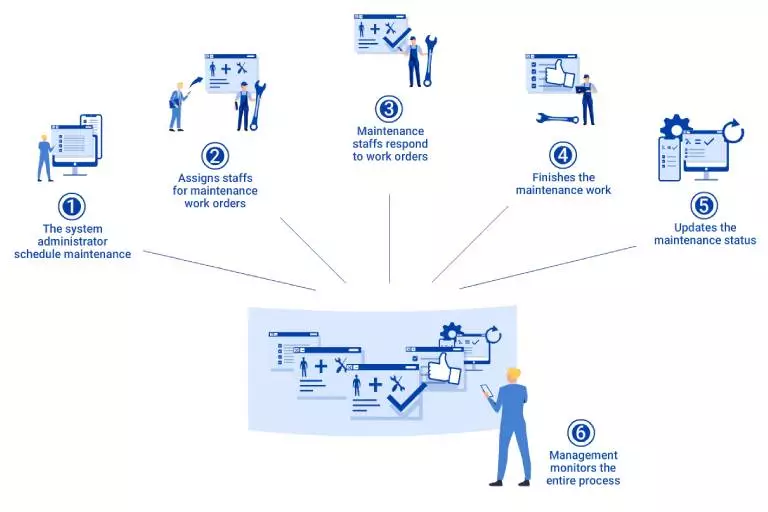
Preventive and predictive maintenance scheduling is non-negotiable — healthcare facilities cannot afford the equipment failures that reactive maintenance allows. Work order management with full asset history provides the documentation foundation that accreditation processes require. Real-time asset monitoring through IoT integration enables condition-based maintenance for life-critical equipment. Mobile accessibility ensures that biomedical equipment technicians can update work orders, access service manuals, and report equipment status from anywhere in the facility. And compliance documentation with mandatory checklist enforcement ensures that no statutory inspection or accreditation-sensitive maintenance task can be closed without the required evidence being captured.
FacilityBot delivers every one of these capabilities as standard across its entry-tier plan — making it the most accessible and most complete healthcare CMMS software for Singapore medical facility managers seeking to elevate their maintenance operations to the standard that clinical environments demand.
Building the Foundation for Safer, More Efficient Healthcare Facilities
Healthcare CMMS software is not a back-office efficiency tool. It is front-line patient safety infrastructure. The maintenance operation that keeps clinical equipment functioning reliably, enforces compliance with statutory and accreditation requirements, and responds efficiently to equipment faults directly determines the safety and quality of care that patients receive.
For Singapore healthcare facilities investing in facility management solutions that meet the full scope of this responsibility, FacilityBot provides the platform that combines clinical environment capability, regulatory compliance management, and transparent organisation-based pricing in a system that deploys rapidly and operates reliably at every scale of healthcare facility management.
