
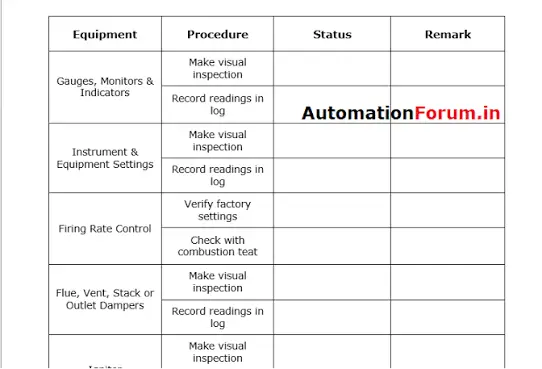
Most boilers run for years without drama, which is exactly why they get neglected. The checklist lives in a binder, the log book has a gap or two, and everyone assumes the safety devices are working because the boiler is.
That assumption is where the risk sits. A boiler stores a large amount of energy under pressure, and the devices that protect people and buildings only protect them if they are tested on time. When incidents are investigated, poor maintenance practice and defective low water cutoffs come up again and again.
This guide sets out a practical boiler maintenance checklist for commercial boiler maintenance: what to inspect, how often, which safety devices must never lapse, which readings to trend, and how to keep the records that inspectors and insurers expect. Always treat it as a framework and work from your boiler manufacturer’s manual, your insurer’s requirements, and local regulations.
Why Commercial Boiler Maintenance Matters
Safety. Low water, overpressure, and flame failure are the classic boiler hazards. Each has a protective device, and each device has to be tested.
Reliability. A boiler failing in winter affects heating, hot water, and sometimes process loads. Most failures show warning signs that routine checks pick up.
Efficiency. Poor combustion tuning, scale on heat transfer surfaces, and excess blowdown all waste fuel.
Equipment life. Water treatment and clean heat transfer surfaces protect tubes, shells, and fittings from scale and corrosion.
Compliance and insurance. Many jurisdictions require periodic inspection by an authorised inspector, and insurers may require documented testing of safety devices. Gaps in records can create liability.
Cost control. A planned repair in summer costs far less than an emergency call-out in a cold snap.
Know Your Boiler Before You Use the Checklist
Tasks differ with boiler type, fuel, and pressure class. Record these basics for each unit:
| Detail | Why it matters |
|---|---|
| Steam or hot water | Steam boilers need water level and blowdown routines that hot water boilers do not |
| Fire-tube or water-tube | Affects inspection access, cleaning methods, and water treatment demands |
| Fuel: gas, oil, or dual | Determines burner, fuel train, and atomisation checks |
| Pressure class and maximum allowable working pressure | Sets relief valve and inspection requirements |
| Condensing or non-condensing | Condensing boilers add condensate drain and neutralisation checks |
| Burner type and controls | Defines flame safeguard, linkage, and tuning tasks |
| Operating regime | Seasonal, continuous, or standby duty changes shutdown and lay-up needs |
Keep the manual, wiring diagrams, controls settings, and last inspection certificate with the asset record.
Safety and Preparation
Boiler work combines combustion, pressure, electrical, and chemical hazards.
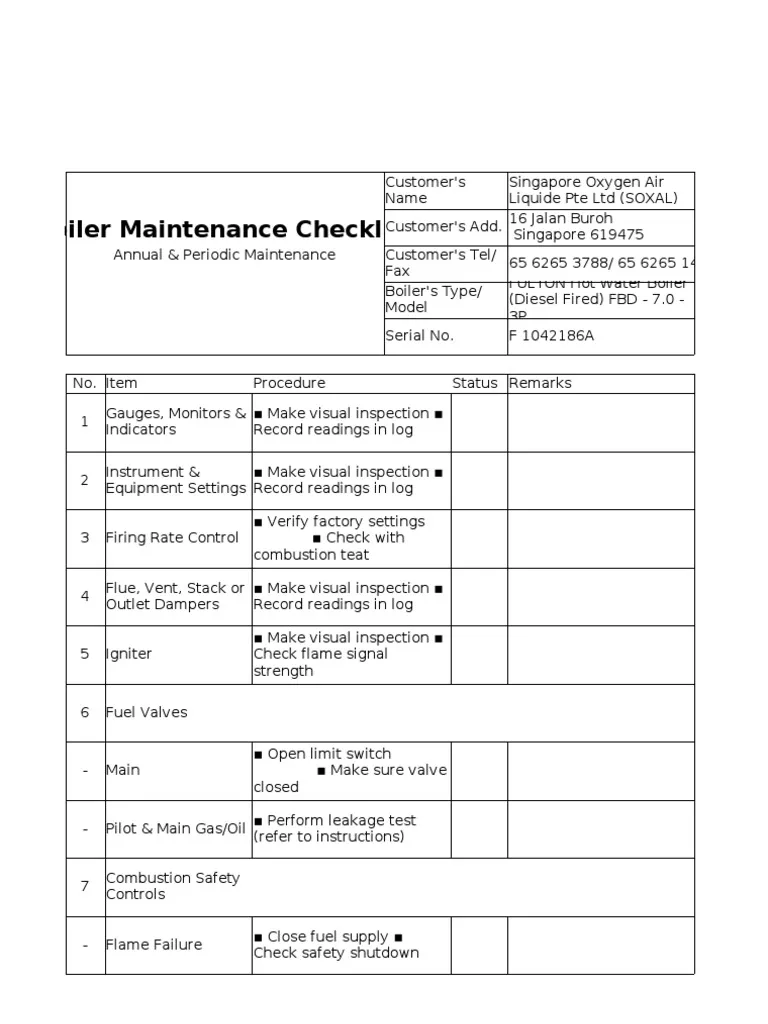
- Follow the manufacturer’s procedures, and only do work you are trained and authorised to perform.
- Use lockout and tagout, and isolate fuel, water, steam, and electrical supplies as required before opening equipment.
- Allow the boiler to cool and relieve pressure before internal work.
- Treat vessels as confined spaces where entry rules apply.
- Ventilate the boiler room and keep combustion air openings clear.
- Use appropriate PPE for heat, chemicals, and electrical work.
- Leave burner adjustment, combustion tuning, controls settings, and pressure vessel repairs to qualified technicians. After a service provider sets the burner, avoid tinkering with linkages, fuel pressures, or control settings.
- Never bypass or jumper a safety device, even temporarily.
- Plan outages with the building, and tell occupants and the BMS operator when a boiler will be offline.
The Four Safety Devices That Cannot Lapse
Most boiler tasks affect efficiency or tidiness. These four decide whether the boiler is safe to run at all, so your schedule must enforce them.
| Safety device | What it does | Typical test approach |
|---|---|---|
| Low water cutoff (LWCO) | Shuts the burner down before water falls below a safe level | Blow down and confirm the burner cuts out, at the frequency set by the manufacturer, code, and insurer |
| Safety (relief) valve | Relieves overpressure and must reseat cleanly | Manual test and periodic certification or replacement |
| High limit or high pressure cutout | Stops the burner before pressure or temperature reaches dangerous levels | Functional test by simulating the condition |
| Flame detection and flame safeguard | Detects loss of flame and locks out the burner safely | Test response to flame failure within the time specified by the manufacturer and applicable codes |
If any of these fails a test, treat it as a priority repair, and do not operate the boiler unprotected.
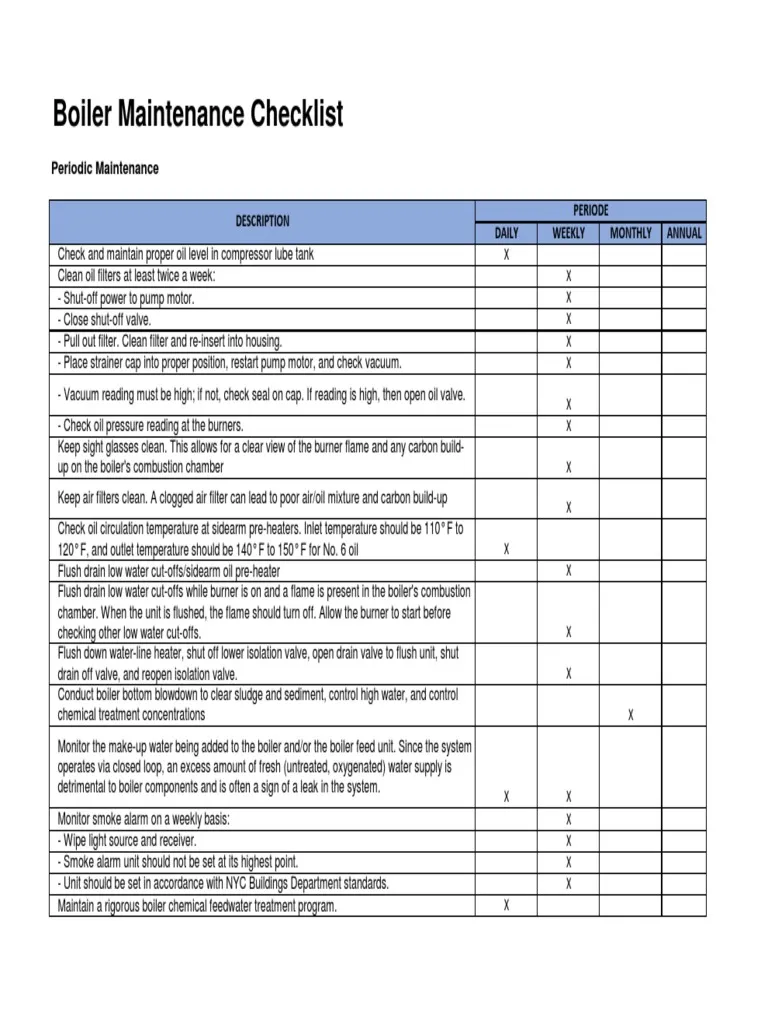
The Boiler Maintenance Checklist by Frequency
The frequencies below follow common practice for commercial boilers. Your manufacturer, insurer, and local authority may require different intervals, so confirm before adopting them.
Daily Checks
- Check the water level in the gauge glass, and record the pressure and temperature gauges
- Record steam pressure on steam boilers, or water pressure and temperature on hot water boilers
- Confirm pressure is within the permitted operating range
- Test the low water cutoff by blowing down the water column or float chamber, and confirm the burner shuts off. Record the result
- Where applicable, test the auxiliary low water cutoff
- Drain the gauge glass and confirm the level returns
- Observe the burner operating control and high limit control cutting in and out at the correct settings
- Confirm a stable flame and normal flue appearance
- Check the burner refractory for broken pieces
- Perform bottom blowdown according to your programme to remove sludge and sediment
- Check feedwater and boiler water chemistry, such as pH and conductivity, per your treatment programme
- Check the boiler room for leaks, noise, odours, and anything unusual
- Record everything in the boiler log book
Weekly Checks
- Repeat the daily tests and inspections
- Inspect and tighten burner and draft control linkages
- Check the burner air damper for smooth operation
- Check gas train valve operation, and operate manual shutoff valves to confirm they move freely
- Check the pilot and igniter, and the condition of the flame
- Test the low water cutoff again by blowing down through the drain and confirming the burner cuts off before the water disappears from the gauge glass
- Check control circuit operation through its phases
- Test the safety relief valve manually, within the limits your manufacturer and code specify
- Simulate a high pressure or high limit condition and confirm the burner shuts down
- Verify flame detection responds to flame loss and the flame safeguard locks out
- Inspect the igniter electrode, porcelain, and cable
- Check the combustion air fan screen and damper
Monthly Checks
- Repeat the weekly tests and inspections
- Test limit controls and operating controls through their settings
- Test flame detection controls
- Inspect and clean the pilot assembly: centre the ignition electrode, check the high tension wire for deterioration, and clean the flame scanner
- Check air dampers for smooth operation and remove lint and dirt
- On oil-fired units, check ignition electrodes, clean the atomising nozzle if needed, inspect oil filters, and check the air compressor filter if used
- Lubricate motors per the motor manufacturer’s instructions
- Check blowdown for signs of sludging
- Verify the blowdown separator and cooler operation
- Check floor drains for proper function
- Check the boiler room fresh air inlet screens and louvres
- Carry out a full water analysis against your treatment programme limits
- Verify chemical dosing rates and recalibrate if needed
- Inspect feed pump bearings and seals
- Calibrate or verify pressure, temperature, and flow instruments
- Carry out flue gas analysis and note oxygen, carbon monoxide, and carbon dioxide readings
Quarterly Checks
- Have a qualified technician tune the burner and check combustion settings, where recommended for your boiler
- Review water treatment results and chemical consumption
- Inspect pipework, valves, and insulation for leaks and damage
- Review log book entries for trends in pressure, temperature, stack temperature, and blowdown frequency
Annual Checks
- Arrange the internal inspection of the pressure vessel by an authorised inspector, carried out cold and isolated, as your jurisdiction requires
- Arrange non-destructive examination where findings call for it
- Disassemble and inspect the low water cutoff and auxiliary low water cutoff for sludge, corrosion, and electrical switch defects
- Inspect the fireside for soot, damage, and deposits, and the waterside for scale and corrosion, and clean inside and out
- Inspect all refractory for fallen or broken pieces
- Hydrostatic test the boiler for leaks at tube joints and piping where required
- Verify burner settings and perform a full combustion tune-up
- Check gas regulator pressure settings
- Replace or recertify safety valves, and bench test where required
- Bubble test fuel train safety shutoff valves
- Carry out a full burner management system functional test
- Renew and display the operating certificate
- If the boiler will be out of service for the summer, follow the manufacturer’s lay-up procedure, including closing manual valves and turning off the burner at the control switch while leaving power on the control panel to protect the flame safeguard from humidity damage
General Housekeeping That Prevents Problems
Some of the most valuable boiler habits are not tasks on a schedule.
- Keep the boiler, burner, and boiler room clean. A tidy plant room makes leaks, drips, and damage easier to spot.
- Keep burner and control covers in place. Electrical contacts in the controls are sensitive to dust and moisture.
- Never close or block combustion air vents. If cold air causes problems for other equipment, use ducting to direct the air rather than shutting the opening.
- Repair all leaks promptly. A small leak at a boiler or burner connection can become a serious one.
- Respond to foaming and priming. On steam boilers, violent fluctuations or sudden drops in the water level in the gauge glass can indicate carry-over caused by dirt, oil, excessive treatment chemicals, or high water level. In serious cases, stop the burner, reduce load, and correct the condition according to the manufacturer’s instructions.
- Limit who can adjust settings. Only trained people should touch controls, fuel pressures, and linkages.
Watch These Readings, Not Just the Boxes
A checklist confirms a task happened. Trended readings tell you whether the boiler is healthy.
| Reading | What to watch for |
|---|---|
| Operating pressure against maximum allowable working pressure | Investigate sustained operation close to the relief setting |
| Stack temperature | A rising trend often points to fouling or poor combustion |
| Flue gas oxygen, carbon monoxide, carbon dioxide | Shows combustion quality and where to tune the air to fuel ratio |
| Feedwater and boiler water chemistry | Hardness, alkalinity, chlorides, phosphate, silica, and conductivity out of range cause scale and corrosion |
| Blowdown frequency and volume | Follow your programme and the manufacturer’s limits, avoiding both too little and too much |
| Makeup water use | Unexpected increases can signal leaks |
| Fuel use per unit of heat delivered | A rise suggests lost efficiency |
| Burner cycling rate | Short cycling points to oversizing or control problems |
| Number of lockouts and alarms | Repeated events need root cause investigation |
Plot a few of these over time. A slow drift is easier to fix than a failure.
Commercial Boiler Problems and What to Check First
| Symptom | Possible causes | First checks |
|---|---|---|
| Burner will not start | Safety lockout, flame safeguard fault, low water, fuel supply, control fault | Alarm history, water level, fuel supply, control status |
| Frequent low water shutdowns | Feedwater problems, foaming, faulty LWCO, leaks | Gauge glass behaviour, feed pump, water chemistry |
| Flame failure or unstable flame | Dirty scanner, poor combustion air, fuel pressure, worn electrode | Scanner, igniter, air damper, fuel pressure |
| High stack temperature | Fouled heat transfer surfaces, poor tuning | Combustion analysis, fireside condition |
| Reduced capacity | Scale, fouling, burner output, flow problems | Water treatment records, burner settings, pumps |
| Safety valve lifting or leaking | Pressure too close to setting, valve seat damage | Operating pressure, valve condition |
| Water hammer or noisy operation | Condensate return problems, trapped water, flow issues | Piping, traps, condensate return |
| Sludge or scale in blowdown | Poor water treatment, inadequate blowdown | Water test results, blowdown programme |
| Leaks | Gasket, tube, or fitting failure, corrosion | Source, pressure, treatment history |
| Unusual smells or soot | Incomplete combustion, flue problems | Combustion analysis, flue, air supply |
For help interpreting alarms from other plant, see our guides on chiller fault codes and fire alarm panel trouble codes, which show how to turn alarm messages into maintenance records.
Water Treatment: The Quiet Driver of Boiler Life
Many boiler failures begin on the waterside. Scale acts as an insulator, forcing higher metal temperatures and wasting fuel. Corrosion thins metal and causes leaks. Poor control of dissolved solids leads to carry-over and foaming.
A sound water treatment programme includes:
- Testing feedwater and boiler water at the frequency your treatment provider sets
- Keeping hardness, alkalinity, chlorides, phosphate, silica, and conductivity within programme limits
- Dosing chemicals accurately, and recalibrating dosing equipment when readings drift
- Controlling blowdown to remove dissolved solids without wasting heat
- Managing condensate return to limit contamination
- Recording all tests, doses, and adjustments
Treatment specifics depend on boiler pressure, make-up water quality, and system type, so work with a qualified water treatment provider.
Spare Parts and Consumables Worth Holding
Keeping a small stock turns a long outage into a short one. Typical items include:
- Gauge glass, gaskets, and washers
- Ignition electrodes and cables
- Flame scanners
- Burner nozzles and oil filters, on oil-fired units
- Control relays, fuses, and contactors
- Pressure and temperature sensors
- Test kits and treatment chemicals
- Lubricants specified by the manufacturer
For plants with several similar boilers, consider holding higher-value spares such as pump seals, motors, and control modules, balanced against supplier lead times.
Documentation: The Log Book and Beyond
A boiler without records is hard to defend in an inspection or an insurance claim. Keep, for each boiler:
- Make, model, serial number, pressure class, fuel type, and installation date
- Manuals, wiring diagrams, and burner and controls settings
- The daily log book of readings and safety device tests, with initials and times
- Weekly, monthly, and annual task records
- Combustion analysis results and tuning records
- Water treatment test results and chemical use
- Safety valve certificates and test dates
- Inspection reports and operating certificates
- Repair records, parts used, and contractor reports
- Alarm and lockout history, with causes and actions
Digital records make this easier to search and prove, which matters when an inspector asks for twelve months of daily tests.
Linking Boiler Data to Your Maintenance System
Boilers produce plenty of data: run hours, firing rates, pressures, temperatures, alarms, and lockouts. Feeding the right signals into your maintenance system can trigger work orders, record accurate downtime, and show trends. The key is to send what drives action, such as alarms, lockouts, run hours, and selected readings, rather than every raw data point. Our guide on real-time asset data in a CMMS explains how to choose what to connect, and our article on OEE for buildings shows how to combine availability, performance, and quality into a single measure of plant health.
Building a Commercial Boiler Maintenance Program
A checklist alone does not maintain anything. To turn it into a program:
- Create an asset record for each boiler and its auxiliaries, such as feed pumps, deaerators, economisers, and burners.
- Convert the checklist into scheduled tasks with frequencies, owners, and expected completion times.
- Separate in-house and specialist work. Operators can usually handle daily logging and routine tests. Burner tuning, pressure vessel inspection, and repairs belong to qualified contractors and authorised inspectors.
- Book annual inspections and certificates early, especially before the heating season.
- Create failure procedures. A failed safety test should raise a priority work order, and the boiler should not run unprotected.
- Train operators to take consistent readings, spot warning signs, and know when to shut down and call for help.
- Track completion and overdue tasks every month.
- Review results and adjust intervals using failure history and trends.
Our guide on how to start a preventive maintenance program covers the foundations in more detail. If you maintain other mechanical plant, our guides on chiller maintenance and air handling unit maintenance cover the cooling and air side of the plant room.
Why the Schedule Belongs in a CMMS
A boiler checklist on paper can lapse silently. In a CMMS it becomes a scheduled, assigned, and recorded task. A CMMS can:
- Issue daily, weekly, monthly, and annual tasks on their own cadence for each boiler
- Capture readings and pass or fail results against the asset, not just a tick
- Escalate failed safety tests into priority work orders
- Store certificates, inspection reports, and manuals with the asset
- Keep a timestamped, signed-off history for inspectors and insurers
- Flag repeat faults such as recurring lockouts or low water trips
To see how this works, read why a CMMS is essential for preventive maintenance and how it can streamline preventive maintenance. If you are comparing platforms, FacilityBot’s CMMS software page shows how asset records, schedules, and checklists connect.
Common Boiler Maintenance Mistakes
Treating safety tests as optional. A skipped low water cutoff test is the kind of gap incident investigations keep finding.
Writing “OK” without testing. A tick without a reading or result proves nothing.
Adjusting burner settings without training. Unqualified tinkering with linkages, fuel pressure, or controls creates hazards and can void service agreements.
Ignoring water treatment. Scale and corrosion quietly shorten boiler life and raise fuel use.
Blocking combustion air. Closing vents to stop draughts starves the burner.
Leaving small leaks. They rarely stay small.
Letting inspection certificates lapse. This can affect insurance and legal compliance.
Overlooking summer lay-up. Idle boilers still need protection from moisture and corrosion.
Skipping the log book. Without history, trends and repeat faults stay invisible.
Waiting for the first cold day. Run a pre-season readiness check before the heating season starts.
Frequently Asked Questions
What is a boiler maintenance checklist?
A boiler maintenance checklist is a structured list of inspections, tests, and servicing tasks for a boiler, organised by frequency such as daily, weekly, monthly, and annually. It covers safety devices, combustion, water treatment, controls, and records.
How often should commercial boilers be serviced?
Operators typically carry out daily checks and logging, with weekly and monthly safety and combustion tests, regular burner tuning by a qualified technician, and a full annual inspection. Exact intervals depend on the manufacturer, boiler type, insurer, and local regulations.
What are the most important boiler safety checks?
Testing the low water cutoff, the safety relief valve, the high pressure or high limit control, and flame detection. These are the devices that keep a boiler from running unprotected, so they must be tested on schedule and recorded.
How often should a low water cutoff be tested?
Many commercial steam boiler routines test it daily by blowing down and confirming the burner shuts off, with additional weekly testing and an annual disassembly and inspection. Confirm the frequency with your manufacturer, insurer, and local code.
Is an annual boiler inspection mandatory?
In many jurisdictions, yes. Pressure vessels typically require periodic inspection by an authorised inspector, and an operating certificate may need to be displayed. Check the requirements that apply where you operate.
Can in-house staff do commercial boiler maintenance?
Trained staff can usually handle daily logging, water level checks, blowdown, visual inspections, and routine tests. Burner tuning, controls adjustment, pressure vessel inspection, and repairs should be done by qualified technicians and authorised inspectors.
How do I keep boilers efficient?
Tune the air to fuel ratio using flue gas analysis, keep heat transfer surfaces clean, maintain water treatment, control blowdown, repair leaks, and trend stack temperature and fuel use for early signs of fouling or drift.
What should be recorded in a boiler log book?
Water level, pressure and temperature readings, safety device test results, blowdown, water chemistry, combustion readings, alarms, repairs, and inspections, each with date, time, and the initials of the person who recorded them.
What should I do if a safety device fails a test?
Do not run the boiler unprotected. Shut it down if required by your procedure, raise a priority work order, notify your supervisor and service provider, and record the failure and the repair.
How does a CMMS help with boiler maintenance?
A CMMS schedules recurring tasks, captures readings and test results against the asset, escalates failed tests into work orders, stores certificates and inspection history, and builds an auditable record for inspectors and insurers.
Simplify Boiler and Facility Management With FacilityBot
A boiler checklist only protects people when every test is done on time and every result is recorded. FacilityBot helps facilities teams make that routine. Our facilities management software holds each boiler’s asset record, checklists, schedules, certificates, and service history in one place, so safety tests and inspections never depend on a binder. As a facility management solution built for lean teams, it connects preventive tasks, contractor visits, and reactive repairs to the equipment they affect. Because it is cloud based CMMS software, operators can log readings, record safety test results, and attach photos from a phone in the boiler room, while managers see overdue tasks across every site. And with built-in fault reporting software, staff and occupants can report a cold zone, a strange smell, or a noisy plant room the moment they notice it, so early warning signs reach your team before they become shutdowns. Book a demo to see how FacilityBot can support your boiler maintenance checklist and commercial boiler maintenance program.
