
For organisations evaluating maintenance management software, one question consistently creates confusion before the selection process even begins: should we be looking at a CMMS or an EAM? The terms are often used interchangeably in vendor marketing, yet they represent genuinely different scopes of capability, different implementation complexity, and different total cost of ownership. Choosing incorrectly — selecting an enterprise asset management platform when a computerised maintenance management system would suffice, or selecting a CMMS when the organisation’s asset lifecycle management needs exceed what it can deliver — leads to either significant overspend or a platform that cannot scale with the business.
Understanding the EAM vs CMMS distinction is the essential first step in any CMMS software comparison process. This guide breaks down exactly what separates the two categories, helps you determine which your organisation actually needs, and reviews the leading CMMS platforms for Singapore facility managers — starting with FacilityBot, the platform that delivers the broadest CMMS capability available in the market today.
What is a CMMS?
A computerised maintenance management system is software designed to drive asset uptime. At its core, a CMMS centralises maintenance information — work orders, asset registers, preventive maintenance schedules, parts inventory, vendor records, and compliance documentation — into a single digital hub that maintenance and operations teams use daily.
CMMS platforms emerged in the 1960s as organisations outgrew paper-based maintenance tracking, and have since evolved to include sophisticated work order management, inspection checklists, mobile field access, KPI dashboards, and increasingly, IoT sensor integration for condition-based maintenance. The defining characteristic of a CMMS is its focus: maintenance, repair, and operations for physical assets once they are installed and operational.
CMMS users are typically maintenance and operations teams, decision-making sits primarily at that operational level, and implementation follows a single, relatively contained cycle — often deployable within days to weeks for cloud-native platforms.
What is EAM?
Enterprise asset management software addresses the entire lifecycle of physical assets — from acquisition and procurement through installation, operation, maintenance, and eventual disposal. Where CMMS asks “how do we keep this asset running,” EAM asks “what is the total value and cost of this asset across its entire existence, and how do we optimise that across our whole portfolio.”
EAM solutions emerged from CMMS in the early 1990s, broadening scope to include capital planning, asset procurement, depreciation tracking, total cost of ownership analysis, reliability-centred maintenance frameworks, and integration with financial and ERP systems. EAM users span finance, maintenance, operations, production, and compliance teams — and decision-making typically involves C-level stakeholders given the financial and strategic scope involved.
EAM implementation is enterprise-wide and phased, reflecting the breadth of business functions the platform touches. This complexity is precisely why EAM platforms historically carried significantly higher implementation costs than CMMS — though SaaS delivery models have narrowed this gap considerably in recent years.
EAM vs CMMS: The Key Differences at a Glance
| Capability Area | CMMS | EAM |
|---|---|---|
| Fundamental focus | Driving asset uptime | Total asset lifecycle management |
| Work order management | ✅ Full | ✅ Full |
| Multi-site work orders | ⚠️ Partial | ✅ Full |
| PM scheduling (calendar/meter) | ✅ Yes | ✅ Yes |
| Condition-based monitoring | ⚠️ Partial | ✅ Full |
| Predictive analytics / AI | ⚠️ Rarely | ✅ Yes |
| Asset hierarchy (site→system→component) | ⚠️ Partial | ✅ Full |
| Asset criticality scoring | ⚠️ Rarely | ✅ Yes |
| Spare parts & auto-reorder | ✅ Yes | ✅ Yes |
| Capital expenditure planning | ❌ No | ✅ Yes |
| Depreciation tracking | ❌ No | ✅ Yes |
| Total cost of ownership analysis | ❌ No | ✅ Yes |
| ERP/finance integration | ⚠️ Partial | ✅ Native |
| Permit-to-work (PTW) | ⚠️ Partial | ✅ Yes |
| ESG/sustainability tracking | ❌ No | ✅ Yes |
| Failure analysis (FMEA/RCFA) | ⚠️ Rarely | ✅ Yes |
| Mobile app & offline mode | ✅ Yes | ✅ Yes |
| Ease of configuration | ✅ Better — low-code, accessible | ⚠️ Complex |
| Typical implementation | Single cycle, days to weeks | Phased, months |
| Primary users | Maintenance & operations | Finance, ops, production, compliance, C-suite |
The pattern that emerges is consistent: CMMS delivers the operational maintenance capability that the vast majority of organisations need day to day, with significantly easier configuration and faster time to value.
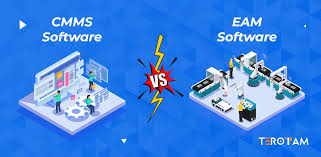
EAM adds the financial, lifecycle, and enterprise-integration layer that becomes necessary primarily for organisations with very large, geographically distributed, asset-intensive portfolios — think utilities, mining, defence, or transportation networks managing thousands of assets across dozens of sites with dedicated finance and compliance teams embedded in asset decisions.
When Do You Actually Need a CMMS?
For the substantial majority of facility management operations in Singapore — commercial buildings, industrial facilities, healthcare campuses, educational institutions, and multi-tenancy property portfolios — a CMMS is not just sufficient, it is the right tool for the job. You need a CMMS if your priorities are reducing unplanned downtime of critical machinery and equipment, lowering repair and emergency breakdown costs, shifting away from reactive maintenance toward preventive workflows, improving workplace and worker safety, and extending asset operational life without requiring enterprise-wide financial integration.
Crucially, modern CMMS platforms have closed much of the functional gap that historically separated them from EAM. The “only more advanced CMMS solutions have some EAM functionality” caveat that applied a decade ago is increasingly outdated — leading CMMS platforms now deliver IoT integration, condition-based maintenance, vendor management, and procurement capabilities that were once EAM-exclusive.
When Do You Actually Need EAM?
EAM becomes the right choice when your organisation needs to track and manage the entire asset lifecycle of physical infrastructure across multiple geographies, when capital expenditure planning and asset valuation decisions are core to financial strategy, when reliability-centred maintenance frameworks and formal failure mode analysis are operational requirements, and when finance, procurement, and compliance teams need direct, native integration with maintenance data for budgeting and depreciation purposes.

If your organisation does not have dedicated asset finance teams making capex decisions based on maintenance data, and your maintenance challenges centre on keeping equipment running reliably rather than optimising decades-long asset investment portfolios, EAM’s additional complexity and cost will likely outweigh its benefits.
Making the Right Choice
The EAM vs CMMS decision ultimately comes down to an honest assessment of your organisation’s asset portfolio scale, the involvement of finance and capital planning teams in maintenance decisions, and your tolerance for implementation complexity and cost. For the overwhelming majority of Singapore facility management operations, a capable CMMS — particularly one like FacilityBot that extends meaningfully into EAM-adjacent territory without EAM-level cost or complexity — delivers everything required to drive asset uptime, control costs, and build the operational data foundation for smarter decisions over time.
