
Last updated: 29 October 2026
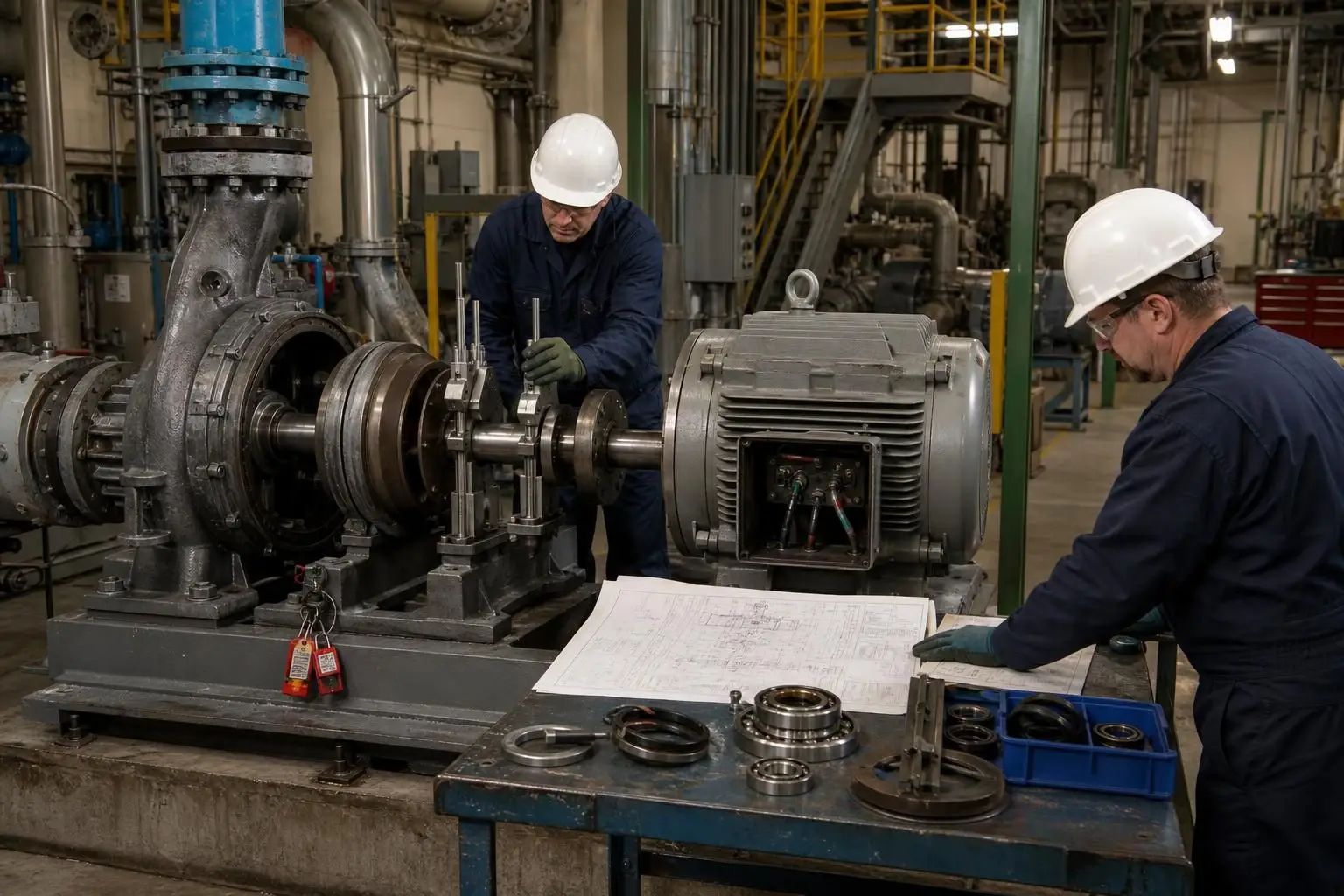
An overhaul is a planned, major restoration of equipment that involves disassembly, detailed inspection, repair or replacement of worn parts, reassembly, testing and documented return to service. For industrial facilities, planning an overhaul means turning that technical work into a controlled programme with a clear scope, approved shutdown window, safe work permits, assigned work orders, acceptance tests and a complete asset history.
Key takeaways
- An overhaul goes beyond routine servicing because it restores equipment condition, performance or remaining useful life through substantial work.
- A strong overhaul plan defines the asset scope, technical standards, parts, labour, safety controls, schedule and acceptance criteria before shutdown begins.
- Digital inspections and work orders create a traceable record of findings, repairs, approvals, test results and future maintenance requirements.
- A CMMS should link the overhaul work order to the asset record, permits, checklists, costs, documents and revised preventive maintenance schedule.
- Post-overhaul commissioning is essential: equipment should return to production only after functional, safety and performance checks meet the agreed criteria.
What is an overhaul in facility maintenance?
An overhaul in facility maintenance is a major planned intervention that returns an asset to an acceptable operating condition by inspecting, repairing, rebuilding or replacing important components.
The overhaul definition differs from a basic service. Routine maintenance may include lubrication, cleaning, adjustments and simple condition checks. An equipment overhaul usually requires a controlled shutdown, partial or full strip-down, measurements against tolerances, replacement of wear items and formal recommissioning.
To define overhaul clearly in a maintenance plan, state the asset, the work boundary and the performance outcome. For example: “Overhaul the chilled-water pump including motor inspection, bearing replacement, seal replacement, alignment, vibration testing and return-to-service verification.”
| Activity | Typical purpose | Level of equipment intervention | Typical record needed |
|---|---|---|---|
| Routine servicing | Preserve normal operation | Cleaning, lubrication, adjustment, visual checks | Service checklist and work completion record |
| Corrective repair | Restore an identified failed function | Repair or replace the failed part | Fault report, repair work order and test result |
| Overhaul | Restore condition, reliability or useful life | Planned disassembly, detailed inspection, rebuild and testing | Overhaul work pack, inspection findings, parts record, permits and commissioning evidence |
| Replacement | Remove an obsolete, uneconomic or unsafe asset | Decommission old asset and install a new one | Replacement project file, commissioning record and asset-register update |
An overhauled asset is not automatically “as new.” Its condition depends on the approved scope, the parts replaced, the quality of workmanship and commissioning results. The objective is to document exactly what was restored and establish the maintenance requirements that follow.
When should a facility schedule an equipment overhaul?
A facility should schedule an equipment overhaul when condition, operating hours, manufacturer guidance, reliability trends, safety exposure or production risk show that routine maintenance no longer provides sufficient control.
Some assets have manufacturer-recommended overhaul intervals, such as compressors, pumps, generators, gearboxes and air-handling equipment. These intervals are useful planning inputs, yet facilities should also consider the real duty cycle, environment, operating load and inspection history. A pump operating continuously with abrasive contaminants, for example, may need overhauling earlier than an identical standby pump.
Use the asset history in a CMMS to identify practical triggers:
- Repeated failures or recurring corrective work orders for the same failure mode.
- Deteriorating vibration, temperature, pressure, flow, energy or quality readings.
- Rising repair cost, downtime or spare-parts consumption.
- A planned production shutdown or low-demand period that creates a workable maintenance window.
- Regulatory, insurer, safety or manufacturer maintenance requirements.
- Inspection findings showing wear beyond defined limits.
Maintenance teams should distinguish an overhaul from ordinary preventive maintenance. A practical preventive maintenance schedule for facility assets keeps routine tasks on time; an overhaul plan manages an infrequent, high-impact job with greater scope, risk and verification needs.
What should an overhaul plan include?
An overhaul plan should include the technical scope, work sequence, safety controls, resources, schedule, quality checks, approval route and closeout documents required to return an asset safely to service.
A useful structure is the SCOPE Framework for Equipment Overhauls: Scope, Controls, Organisation, Proof and Evolution. Each element prevents a common failure in major maintenance work.
Scope: What exactly will be overhauled?
The scope should identify the asset by its tag or unique asset ID, location, system relationship and duty. Define the equipment boundary so technicians and contractors know whether connected equipment, controls, cabling, pipework, guards or foundations are included.
The scope should also specify:
- Reason for the overhaul and relevant failure history.
- Components to inspect, measure, repair or replace.
- Drawings, manuals, bills of materials and approved technical specifications.
- Required consumables, spares, specialist tools and lifting equipment.
- Work excluded from the current shutdown.
- Acceptance criteria, such as alignment tolerance, leak-free operation, vibration limits or required operating output.
Avoid vague scope statements such as “service compressor.” A precise scope makes quotations comparable, supports accurate work assignment and reduces unplanned additions after equipment is opened.
Controls: How will the work be carried out safely?
The overhaul plan must identify hazards and apply site-approved controls before work starts. Industrial and manufacturing overhauls commonly involve electrical isolation, stored energy, pressure systems, hot work, work at height, confined spaces, lifting operations and hazardous substances.
The permit process should connect each control to the specific asset and work period. FacilityBot’s e-Permit to Work module can help teams issue, review and retain permit records alongside the related work order, rather than leaving approval evidence in disconnected paper files or chat threads.
For safety planning, confirm:
- Isolation points, lockout/tagout steps and verification of zero energy.
- Permit type, authorised issuer, receiver and validity period.
- Risk assessment and method statement requirements for contractors.
- Emergency arrangements, access controls and communication procedures.
- Required personal protective equipment and competency certifications.
- Handover conditions before work begins and before the asset returns to operations.
Where an overhaul affects critical utilities or production systems, operations and maintenance leaders should agree on contingency arrangements before the outage begins.
Organisation: Who owns each task and deadline?
The overhaul work order should assign accountable people, planned dates, estimated labour and dependencies for every significant task. One major work order can serve as the parent record, with child work orders for inspection, mechanical work, electrical work, controls, cleaning, testing and restoration.
| Work package | Typical owner | Required completion evidence | Dependency |
|---|---|---|---|
| Pre-overhaul inspection | Maintenance engineer or competent technician | Baseline checklist, photos and measurements | Must finish before final scope approval |
| Isolation and permit issue | Authorised operations and safety personnel | Approved permit and isolation verification | Must finish before disassembly |
| Disassembly and inspection | Mechanical contractor or maintenance team | Findings, measurements and component condition | Requires safe release of equipment |
| Repair and parts replacement | Assigned technician or contractor | Parts used, repair notes and torque/alignment records | Depends on inspection findings and parts availability |
| Reassembly and functional testing | Maintenance team with operations support | Test checklist and defects list | Requires completed mechanical and electrical work |
| Commissioning and handback | Asset owner or authorised approver | Signed acceptance and work-order closure | Requires successful tests and area restoration |
A CMMS makes these work packages visible as planned work rather than relying on verbal updates. It also gives supervisors a clear view of blocked tasks, overdue approvals and unplanned work found during disassembly.
Proof: What evidence shows the overhaul met requirements?
An overhaul is complete only when the facility has evidence that the defined scope and acceptance criteria were met. Evidence protects safe operation, supports audit readiness and helps the next maintenance team understand what changed.
Use digitised inspection checklists for pre-work condition, strip-down findings, dimensional checks, reassembly, functional testing and final acceptance. The detailed guidance in digitised facility inspections, checklists, SOPs and compliance audit trails explains how structured checklists create consistent, retrievable inspection evidence.
Typical closeout records include photos, readings, calibration certificates, test results, parts serial numbers, warranty documents, contractor reports and signed handover approval. A digital record should remain attached to the asset history instead of being stored only in an individual inbox or paper binder.
Evolution: How will future maintenance change?
An overhaul should update the asset’s future maintenance plan using what the team learned during the work. Record the actual failure modes, replaced components, condition findings, root causes where known, labour hours, materials and outage duration.
The maintenance planner can then adjust task frequencies, inspection points, spare-parts holdings and condition-monitoring routes. ISO 55000 provides an international framework for asset management systems, and its lifecycle perspective is useful here: overhaul decisions should support asset value, risk control and organisational objectives over time.
How do inspections determine the final overhaul scope?
Inspections determine the final overhaul scope by converting observed equipment condition into approved repair, replacement and test actions.
A planning inspection occurs before the shutdown and helps estimate materials, labour and access needs. The detailed inspection occurs after safe disassembly, when technicians can see internal wear, contamination, clearances, corrosion, cracks or damage. The plan should anticipate this second stage because some findings cannot be confirmed while the asset remains assembled.
Build decision rules into the inspection checklist. For each critical component, identify what to inspect, how to measure it, the acceptable limit, the evidence required and the escalation path if it fails. This prevents inconsistent decisions between shifts, sites or contractors.
| Inspection result | Planned response | Work-order action |
|---|---|---|
| Condition is within tolerance | Clean, reassemble and test | Complete planned task with readings attached |
| Wear is approaching the limit | Replace during the scheduled shutdown if parts are available | Add approved corrective subtask and record part number |
| Condition exceeds the limit or presents a safety risk | Stop affected work, assess impact and obtain approval for expanded scope | Raise change request, revise schedule and notify stakeholders |
| Root cause is unclear | Conduct further analysis before return to normal duty | Create follow-up investigation or monitoring work order |
Documenting this logic is especially valuable for rotating equipment and critical utilities, where a missed defect can cause an extended outage after restart. Teams can also use condition and reliability data to inform the decision; see equipment reliability metrics including MTBF, MTTR, availability and OEE for definitions that help evaluate asset performance before and after major work.
How should work orders be structured for an overhaul?
Overhaul work orders should be structured as a parent work order with controlled child tasks, each linked to the same asset, shutdown period, permits, documents and acceptance process.
The parent work order is the management record. It should contain the business reason, approved budget or cost code, schedule, asset details, outage impact, overall scope, main contractor and final acceptance authority. Child work orders provide actionable instructions for specialised teams.
A complete work order for overhauling should capture the following fields:
- Asset ID, name, location, manufacturer, model and criticality.
- Problem statement or planned overhaul trigger.
- Task instructions, drawings, SOPs and required tools.
- Assigned team, contractor, supervisor and approver.
- Scheduled start and finish dates, plus dependencies.
- Required permits, isolations and safety documents.
- Inspection checklist and component-level findings.
- Labour time, materials, parts, purchase references and external service costs.
- Test procedure, acceptance result and handback approval.
- Post-overhaul maintenance requirements and next due date.
A messaging-first reporting process can also improve early planning. When operators report abnormal noise, leakage, heat or performance through familiar channels, FacilityBot can convert the report into a traceable fault record and work order. That record gives planners useful context when deciding whether a repair is sufficient or a scheduled overhaul is warranted.
What maintenance requirements apply after an overhaul?
Post-overhaul maintenance requirements should define the inspections, monitoring, operating limits and preventive tasks needed to protect the rebuilt equipment from early failure.
The work does not end at handback. Many assets need heightened observation during initial operation, including checks for leakage, vibration, abnormal temperatures, alignment movement, control response and load performance. Record baseline readings after commissioning, because those readings form a useful reference for later condition checks.
Update the CMMS with:
1. The completion date and a concise summary of work performed. 2. Components replaced, including part and serial numbers where relevant. 3. New warranties, certificates and contractor documentation. 4. Revised preventive maintenance tasks and frequencies. 5. Initial follow-up inspections after return to service. 6. Updated operating instructions, critical spares and asset condition rating.
If the overhaul addresses an unsafe condition, make sure the associated safety learning reaches frontline teams. The distinction between unsafe acts and unsafe conditions in workplace safety and health is useful when documenting whether the root issue involved equipment condition, work practice or both.
How do you preserve an audit trail for an equipment overhaul?
An audit trail for an equipment overhaul is a chronological, retrievable record showing who authorised the work, what was found, what was changed, how safety was controlled and who accepted the asset back into service.
Paper forms can support a small job, but major work often produces too many moving documents for reliable manual filing. A CMMS creates stronger traceability when each work order, checklist, attachment, status change, permit and approval is linked to the same asset record.
At minimum, retain the approved scope, risk controls, inspection findings, change approvals, parts used, test evidence, completion timestamps and handback sign-off. Permission-based access and time-stamped updates also make it easier to show that records were reviewed and approved by the right roles.
Digital records help facility managers answer practical questions months later: When was the equipment last overhauled? Why was it done? Which bearings or seals were installed? What readings were achieved at commissioning? Which maintenance requirements changed afterward?
How can a CMMS improve overhaul planning and cost control?
A CMMS improves overhaul planning by centralising asset history, work orders, inspections, permits, schedules, documents and cost records in a single operational record.
This visibility lets teams plan labour and materials before shutdown, compare actual work against the initial scope and make evidence-based decisions about future repairs or replacement. FacilityBot’s work order management, preventive maintenance, digitised checklists, CMMS and e-Permit to Work capabilities can connect these stages from initial condition finding through safe handback.
CMMS cost depends on the scope of modules, assets, users, integrations and implementation support required. Review FacilityBot pricing alongside the cost of fragmented records, repeat failures and avoidable outage extensions when evaluating an overhaul-management approach.
A well-planned overhaul is a controlled asset-restoration programme, not simply a large repair. Define the scope, inspect against clear criteria, assign work through structured work orders, control safety through permits, document commissioning and update maintenance requirements from the evidence gathered. To see how FacilityBot can support audit-ready overhaul planning in an industrial facility, book a FacilityBot demo.
