
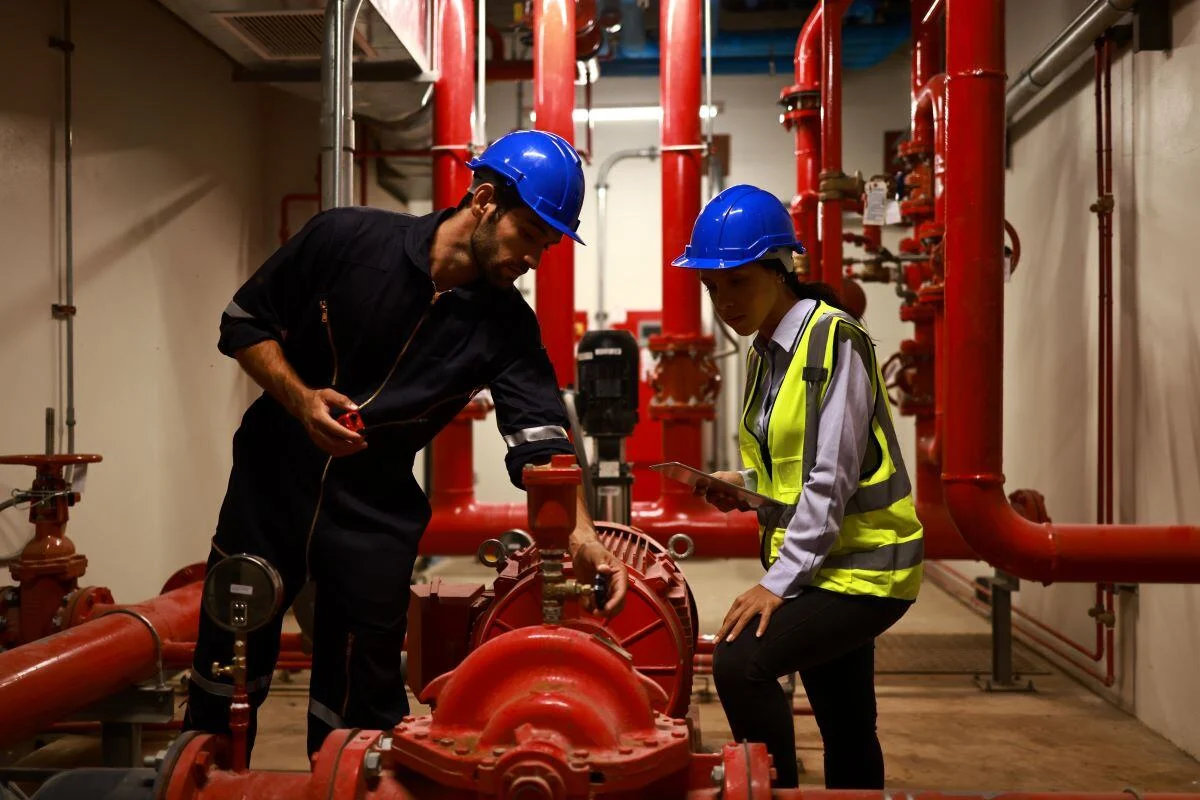
A fire pump spends almost its entire life doing nothing. It sits in a pump room, quiet and clean, waiting for the one day a sprinkler system demands more pressure than the water supply can give. On that day, nothing else matters except whether it starts, whether it delivers, and whether it keeps running.
That long idle life is exactly what makes fire pump maintenance so easy to neglect and so costly to get wrong. A pump that runs for ten minutes a week can hide a failing battery, a closed valve, a misaligned coupling, or a controller fault for months. The only defence is a disciplined schedule of inspections and tests, with records that prove they happened.
This guide sets out what fire pump maintenance involves, the typical requirements by frequency, and a practical fire pump testing checklist you can adapt for electric and diesel pumps. Treat it as a framework and work from the current edition of NFPA 25, NFPA 20, your manufacturer’s manual, your insurer’s requirements, and the rules your authority having jurisdiction (AHJ) enforces, because details differ by edition and location.
What a Fire Pump Does
A fire pump boosts water pressure from a municipal supply or on-site storage to the sprinklers, standpipes, or hydrants that need it. It is typically driven by an electric motor or a diesel engine, and it is started and monitored by a dedicated controller. In some buildings, both are installed for redundancy.
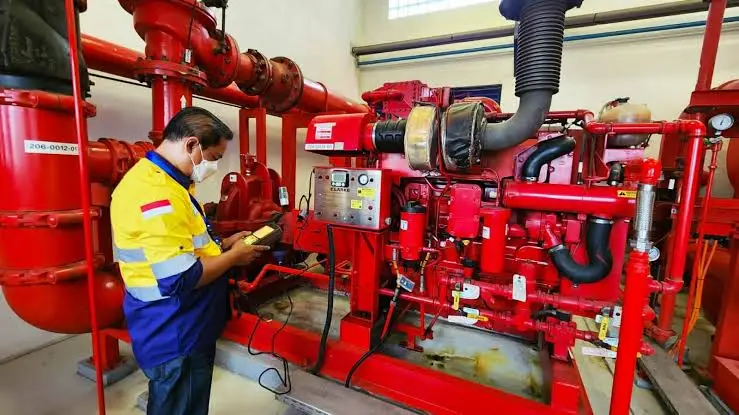
The pump is only one part of a chain that has to work together:
- The water supply: mains, tanks, or reservoirs
- The suction piping and valves
- The pump and its driver
- The controller and any transfer switch
- The discharge piping, relief valves, and test header
- Signals to the fire alarm system and monitoring station
A failure anywhere in that chain defeats the pump, so a good program checks all of it, not just the machine.
Why Fire Pump Maintenance Matters
Life safety. The pump is what keeps sprinklers and standpipes effective in a large or tall building. A failure during a fire can be catastrophic.
Compliance. Codes and standards expect fire pumps to be inspected, tested, and maintained on a defined schedule, and AHJs expect to see the records.
Insurance. Insurers often require documented testing. Gaps in records can affect coverage and premiums.
Reliability after long idle periods. Seals dry out, batteries lose charge, valves get left in the wrong position, and fuel degrades. Regular runs expose these problems.
Early warning. Annual performance testing reveals pump wear and supply degradation before they threaten real performance.
Cost control. A planned repair is far cheaper than an emergency one, and far cheaper than an impairment that requires a fire watch.
Know Your Pump Before You Use the Checklist
Tasks differ with the driver, installation, and standard applied. Record these details for each pump:
| Detail | Why it matters |
|---|---|
| Electric or diesel driver | Diesel pumps have engines, batteries, fuel, and cooling systems that electric pumps do not |
| Rated flow and pressure | Defines the test points and acceptance criteria |
| Pump type | Horizontal split case, vertical turbine, end suction, and others have different inspection points |
| Controller type and settings | Pressure switch settings determine automatic start behaviour |
| Water source | Municipal supply, tank, or reservoir changes suction checks |
| Jockey pump presence | Maintains system pressure and affects how often the main pump starts |
| Standards and edition applied | Intervals and test methods vary by edition and AHJ |
| Acceptance test curve | The baseline against which all later flow tests are compared |
Keep the factory and field acceptance test data with the asset record. Without a baseline, you cannot tell whether performance is slipping.
Safety and Preparation
Fire pump work involves rotating machinery, high pressure water, electrical power, engines, and fuel.
- Only qualified people should test and service fire pumps. Follow the competency requirements in the standards and your AHJ’s rules.
- Notify the right people before testing. This typically includes the AHJ where required, the fire department or monitoring station, building management, and occupants.
- Prevent accidental system activation, and confirm downstream isolation and discharge arrangements for test water.
- Use lockout and tagout where mechanical or electrical work is involved.
- Control the discharge from flow tests, including drainage and ground conditions.
- Never leave the system impaired without a plan. If the pump or any part of the water supply must be out of service, follow your impairment procedure, which may include notification, a fire watch, and restoring protection as fast as possible.
- Keep the pump room safe. Clear access, adequate lighting, ventilation for diesel engines, and no storage around equipment.
- Follow the manufacturer’s instructions and do not bypass safeties or controllers.
Fire Pump Maintenance Requirements by Frequency
The structure below follows the common pattern of weekly, monthly, quarterly, and annual cycles. Exact tasks and intervals depend on the edition of NFPA 25 adopted where you operate, the pump driver, and your AHJ, so confirm before you adopt them.
Weekly Inspection
Weekly checks are mostly visual and operational, and they are where many problems are caught first.
- Check the pump house or room: temperature within the required range, adequate ventilation and heat, lighting working, no water on the floor, clear access
- Check the pump system: suction, discharge, and bypass valves open and in their correct, supervised or locked positions
- Check that pressure gauges on the system, suction, and discharge read normal values
- Check that suction reservoir or tank levels are correct, where applicable
- Check the controller: normal power indicator on, no alarm, trouble, or phase failure indications
- Check for leaks at piping, glands, and fittings
- For diesel pumps, check the engine and its auxiliaries: fuel tank level, oil level, coolant level, battery condition and charger status, engine heater operation, and any alarms
- Check pump packing or mechanical seal for acceptable leakage, and look for signs of overheating
Weekly Run (No-Flow or Churn Test)
Most programs include a regular run of the pump without flowing water, often called a churn test, to prove that it starts and runs smoothly.
- Diesel pumps are generally run weekly, with run duration set by the standard and manufacturer
- Electric pumps are commonly run weekly or monthly, depending on the edition of the standard and local requirements
- Start the pump using the controller’s automatic or manual test method as your procedure specifies
- Run for the required period, and record suction pressure, discharge pressure, and the time taken to reach rated speed
- Check for abnormal noise, vibration, overheating, and excessive packing leakage
- For diesel units, record oil pressure, coolant temperature, battery charging, and exhaust condition
- Record everything, including start and stop times, who carried out the test, and any deficiencies
Monthly Checks
- Complete the weekly checks
- Inspect and test the controller, including verifying operation of pressure switches and alarms
- Check gauges against a calibrated test gauge, and replace any outside tolerance
- Check pump and motor bearings for temperature, noise, and lubrication
- Verify coupling condition and check alignment where scheduled
- Check mounting and foundation bolts for tightness
- Inspect electrical connections for heating, discolouration, and looseness
- On electric pumps, check voltage and current on each phase, and look for imbalance
- Where an automatic transfer switch supplies the pump, test its operation as the applicable standards and manufacturer require
- Where specified, carry out motor insulation resistance checks, which should be done by a qualified person
- Check the jockey pump operation and its controller
Quarterly Checks
- Complete the monthly checks
- Test the automatic start sequence by simulating system demand, such as opening the test header or relieving pressure, and record the time from pressure drop to pump running
- For diesel pumps, load test the starting batteries and check specific gravity or condition, and replace any that fail to meet requirements
- Operate suction, discharge, and test header valves through a full cycle, and confirm OS&Y valves show correct position and supervision
- Test supervisory and alarm signals, including pump running, power failure, phase reversal, and controller trouble, and confirm they reach the fire alarm panel and monitoring station
- Inspect diesel fuel quality, storage, and filters according to the manufacturer and standards
- Check the engine cooling system, heat exchanger, and exhaust
Annual Performance Test
The annual flow test is the most important evaluation of a fire pump, because it shows whether the pump can still deliver what it was designed to deliver.
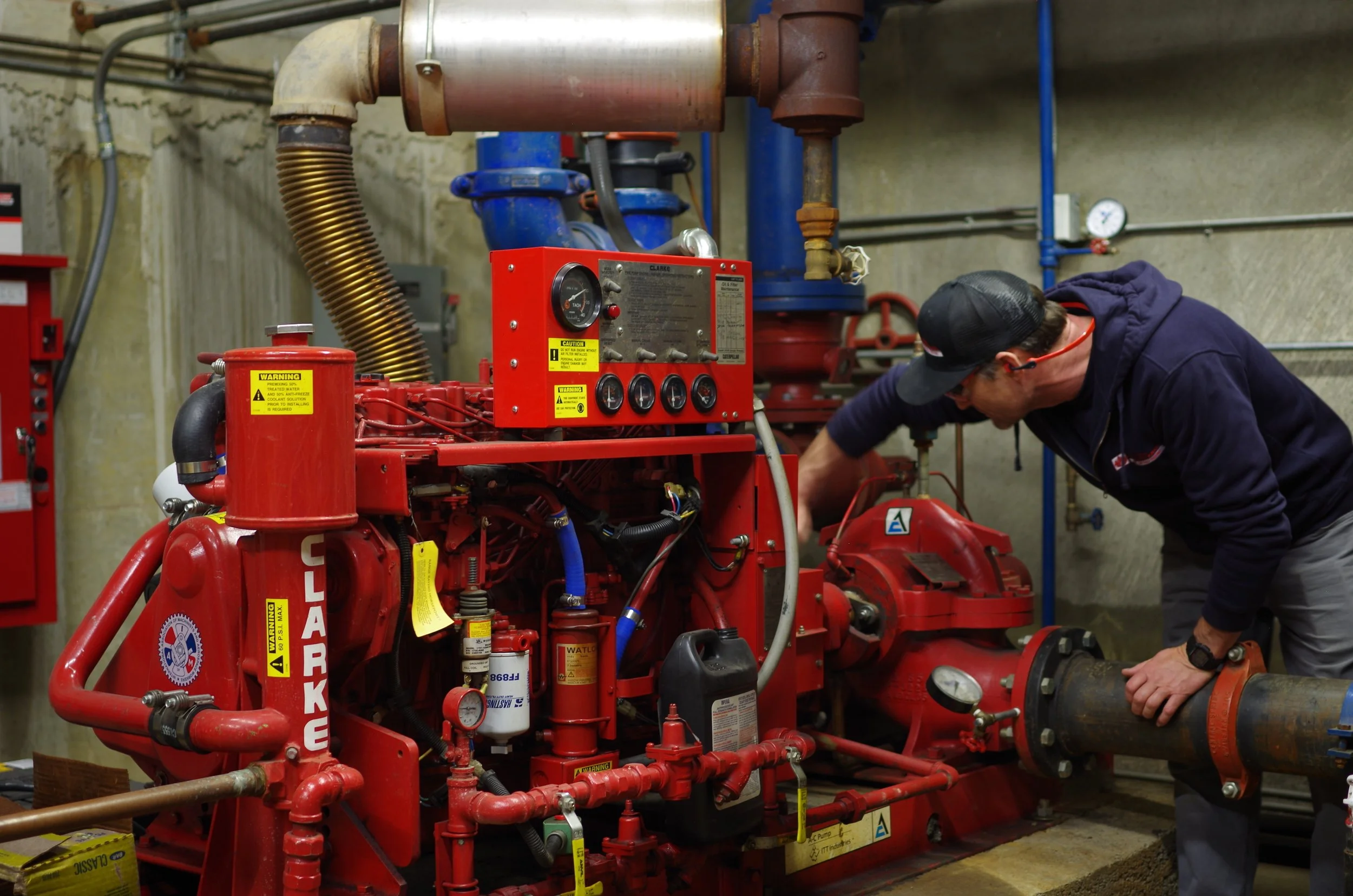
Typical steps include:
- Coordinate and notify. Inform the AHJ if required, the monitoring company, the fire department where needed, building management, and occupants.
- Prepare the test. Confirm the discharge arrangement, test header or flow meter setup, calibrated gauges, and safe drainage.
- Record baseline readings. Note static suction and discharge pressures, and compare with earlier tests.
- Measure the performance curve. Test at no flow (churn), at rated capacity, and at peak flow, commonly 150% of rated capacity, recording flow, suction pressure, discharge pressure, speed, voltage and current, or engine readings.
- Compare with the baseline. Plot results against the acceptance test curve and previous annual tests to spot degradation.
- Test diesel drivers under load. Run for the duration the standard requires and record engine and cooling parameters at intervals.
- Verify alarms and automatic functions, including signals to the fire alarm panel and monitoring station.
- Check controller settings, pressure sensing, and start and stop sequences against the approved design.
- Document and report. Complete the required forms with results, instrument calibration, and the people involved, and distribute copies to the property owner and AHJ as required.
- Raise corrective actions for any deficiency, and restore the system to full service.
A pump that cannot meet its rated performance, or fails to start automatically, must be repaired or managed under your impairment procedure until it is back in compliance.
Annual and Longer-Interval Inspections
- Inspect pump casing, impeller, shaft, sleeves, and wear rings as manufacturer guidance and test results indicate
- Check and adjust packing or replace mechanical seals
- Lubricate bearings to the manufacturer’s specification
- Check pump and driver alignment
- Service the controller and test components
- Inspect and service diesel engines, including oil and filter changes, coolant checks, belts, hoses, and exhaust
- Inspect fuel storage tanks and treat or replace fuel as required
- Check suction tanks for sediment, corrosion, leaks, and algae, and clean as required
- Inspect piping, supports, and flexible connections
- Test pressure relief valves, and recalibrate or replace as needed
- Review spare parts and replace consumables that have reached their service life
The Fire Pump Testing Checklist at a Glance
| Frequency | Typical tests and inspections |
|---|---|
| Weekly | Pump room conditions, valve positions, gauges, controller status, leaks, diesel fuel, oil, coolant and battery status, and a no-flow run for diesel pumps and for electric pumps where required |
| Monthly | Electric pump no-flow run where applicable, controller and gauge checks, bearing and coupling inspection, electrical checks, transfer switch test, jockey pump check |
| Quarterly | Automatic start test, diesel battery load test, full valve cycle, supervisory signal test, fuel and cooling checks |
| Annual | Full flow test at multiple points, diesel extended run, alarm verification, pressure relief valve test, tank inspection, alignment, lubrication, and engine service |
| As required | Impairment procedures, post-repair retests, and tests after major system changes |
Always check which tests your edition of the standard and your AHJ require, and at what interval.
Diesel Fire Pumps: Extra Attention to Batteries and Fuel
Diesel pumps have more to go wrong, and most failures involve the same few items.
- Batteries. Check voltage, charger operation, connections, and terminals. Keep terminals clean and tight, and replace batteries before they fail a load test, not after.
- Fuel. Keep the tank at the required level, check for water and sediment, and replace or treat fuel that has aged. Fuel left standing for years can degrade.
- Cooling. Check coolant level, hoses, belts, and heat exchanger or radiator condition. Overheating during a long run is a common failure.
- Engine heaters. Cold engines may not start reliably. Confirm block heaters are working and the room stays within the temperature range.
- Exhaust and ventilation. Check for leaks, blockages, and adequate ventilation for combustion air.
- Controller start sequence. Verify that both starting batteries and both start attempts work as designed.
Electric Fire Pumps: Power and Controller Reliability
For electric pumps, the question is whether power and the controller will be there when needed.
- Confirm the power supply, disconnects, and breakers are correctly arranged and labelled
- Check the controller’s pressure sensing line and settings
- Verify phase monitoring and alarm operation
- Test the transfer switch if the pump is supplied from emergency power, and consider related generator testing
- Check motor temperature, current, and voltage balance during runs
- Make sure nobody has switched off or locked out the supply without following the impairment process
Water Supply and Suction Checks
A fire pump is only as good as the water it receives.
- Confirm municipal connections or tanks provide adequate flow and pressure
- Check that suction valves are fully open and supervised
- Inspect tanks for leaks, sediment, corrosion, and biological growth
- Monitor suction pressure and water level to avoid cavitation, which damages the pump
- Check strainers and screens where fitted
- Compare static suction pressure with earlier readings, since a drop may point to a supply problem
Reading the Warning Signs
| Symptom | Possible causes | First checks |
|---|---|---|
| Pump fails to start automatically | Controller fault, pressure switch setting, power or battery problem, closed valve | Controller alarms, battery state, pressure sensing line, valve positions |
| Slow start | Weak batteries, engine problems, controller delay | Battery load test, fuel and cooling, controller settings |
| Excess vibration or noise | Misalignment, bearing wear, cavitation, loose mounting | Alignment, bearings, suction conditions, bolts |
| Overheating | Poor lubrication, overtight packing, cooling failure | Packing adjustment, bearing temperature, coolant |
| Excessive packing leakage | Worn packing or sleeves, loose gland | Packing condition and adjustment |
| Low discharge pressure or flow in test | Impeller wear, blocked suction, supply decline, incorrect speed | Suction pressure, impeller condition, test setup, driver speed |
| High churn pressure | Control issues or system design problems | Compare with acceptance test, review with the pump specialist |
| Gauge readings out of tolerance | Failed or drifted gauges | Compare against a calibrated test gauge |
| Supervisory signal not received | Wiring or panel fault, monitoring connection | Signal path to the fire alarm panel and monitoring station |
| Controller trouble or phase alarm | Supply issue, controller fault | Power supply, phase condition, controller diagnostics |
When an alarm or trouble signal appears on the pump controller or fire alarm system, treat it as a maintenance record, not just an interruption. Our guide to fire alarm panel trouble codes explains how to read, record, and escalate these signals.
Documentation: The Records Inspectors Ask For
Missing paperwork is a common reason well-maintained pumps still fail inspections. Keep, for each fire pump:
- Make, model, serial number, rated capacity and pressure, driver type, and installation date
- Acceptance test data and the original pump curve
- Manuals, controller documentation, and approved design drawings
- Weekly and monthly inspection and run logs, with date, time, tester, and readings
- Quarterly test results
- Annual flow test data, instrument calibration records, and comparison with the baseline curve
- Battery test results, fuel records, and engine service history
- Impairment notices and restoration records
- Deficiency reports and the corrective actions taken
- Contractor and laboratory reports and certificates
- Photographs of condition before and after major work
Retention rules vary, so confirm how long your standard, AHJ, and insurer expect you to keep each type of record. Many facilities keep annual flow test data for the life of the system because it forms the baseline for future tests.
Common Fire Pump Deficiencies
Inspections tend to find the same problems again and again:
- Missing or incomplete weekly and monthly run logs
- Batteries that are weak, corroded, or low on electrolyte
- Gauges outside calibration tolerance
- Valves not in the correct position or not supervised
- Supervisory signals not reaching the monitoring station
- Coupling misalignment causing vibration
- Corroded or leaking packing glands
- Low fuel or contaminated fuel on diesel units
- Controller alarms left unaddressed
- Annual test results missing or not compared with the baseline
Almost all of them are preventable with a clear schedule, trained staff, and records captured at the time of the task.
Linking Fire Pump Data to Your Maintenance System
Fire pumps generate useful data: run status, start counts, run hours, pressure readings, controller alarms, and supervisory signals. Feeding the right events into your maintenance system lets a controller trouble or a failed start raise a work order automatically with the asset, time, and recent history attached. As with other plant, send what drives action rather than every data point. Our guide on real-time asset data in a CMMS explains how to choose what to connect, and our article on OEE for buildings shows how to measure availability for critical assets that must work on demand.
Building a Fire Pump Maintenance Program
A checklist alone does not keep a pump ready. To turn it into a program:
- Create an asset record for every pump, including controller, driver, jockey pump, tanks, and valves.
- Convert the checklist into scheduled tasks with frequencies, owners, and expected completion times.
- Define who is qualified for each task. Separate routine in-house inspections from work that must be done by qualified fire protection contractors.
- Book annual flow tests and diesel services early, and coordinate with the AHJ and monitoring company.
- Set an impairment procedure with clear notification steps, interim protection, and restoration checks.
- Stock critical spares, such as batteries, filters, belts, hoses, gauges, packing, and fuses.
- Track completion and overdue tasks every month, and escalate missed safety tests quickly.
- Review trends and results, especially annual flow curves, battery test results, and repeat alarms.
- Train staff to run tests consistently, spot warning signs, and know when to stop and call for help.
Our guide on how to start a preventive maintenance program covers the foundations in more detail. If you maintain other plant-room equipment, our guides on boiler maintenance checklists, chiller maintenance, and cooling tower maintenance cover the rest of the mechanical plant.
Why a CMMS Suits Fire Pump Compliance
Fire pump compliance is a scheduling and records problem as much as a technical one. A CMMS helps by:
- Issuing weekly, monthly, quarterly, and annual tasks automatically and reminding technicians before they are due
- Capturing readings and pass or fail results against the pump, not just a tick
- Escalating overdue or failed tests to supervisors and into priority work orders
- Storing manuals, acceptance curves, certificates, and test reports with the asset
- Keeping timestamped, signed-off history that can be produced quickly for an AHJ or insurer
- Flagging repeat faults, such as recurring battery failures or controller alarms
A CMMS does not replace qualified personnel. It gives them a reliable framework so required inspections are scheduled, completed, and documented.
To see how this works, read why a CMMS is essential for preventive maintenance and how it can streamline preventive maintenance. If you are comparing platforms, FacilityBot’s CMMS software page shows how asset records, schedules, and checklists connect.
Common Fire Pump Maintenance Mistakes
Treating the weekly run as optional. Short, regular runs are what reveal start and seal problems.
Letting valves drift out of position. A closed suction valve defeats an otherwise perfect pump.
Ignoring battery health. Replace batteries on condition, before they fail.
Skipping the baseline comparison. A flow test without comparison to the acceptance curve cannot show degradation.
Letting controller alarms sit. A trouble light is a defect, not decoration.
Leaving gauges uncalibrated. Faulty gauges make test results meaningless.
Failing to plan impairments. Taking a pump out of service without notification and interim protection creates risk and liability.
Keeping records in binders nobody checks. Missing logs are one of the most common findings.
Assuming someone else is testing. Make ownership explicit for every task.
Overlooking the water supply. Suction conditions are as important as the pump.
Frequently Asked Questions
What is fire pump maintenance?
Fire pump maintenance is the routine inspection, testing, servicing, and documentation of a fire pump and its associated equipment, including the driver, controller, valves, water supply, and alarm signals, so that it starts and performs reliably during a fire.
How often should a fire pump be tested?
Typical programs include weekly inspections and a weekly or monthly no-flow run depending on driver type, edition of the standard, and AHJ, monthly and quarterly functional tests, and an annual full performance test. Confirm exact frequencies for your site.
What is a churn test?
A churn test runs the pump with no water flowing to the system, so you can confirm it starts, reaches speed, and runs smoothly, and record pressures and conditions. It is a routine operational check, not a measure of full capacity.
What is a fire pump flow test?
A flow test measures the pump’s output at several flow rates, typically no flow, rated flow, and a higher peak flow, to confirm it can deliver the required water and pressure. Results are compared with the acceptance test curve to detect degradation.
What should a fire pump testing checklist include?
A fire pump testing checklist should cover pump room conditions, valve positions, gauges, controller status, leak checks, weekly and monthly runs, automatic start tests, battery and fuel checks for diesel units, supervisory signal tests, the annual flow test, alarm verification, and records of results and corrective actions.
What are the most important diesel fire pump checks?
Battery condition and charging, fuel level and quality, coolant and oil levels, engine heater operation, and a reliable automatic start. Most diesel failures involve one of these items.
Who can perform fire pump testing?
Standards generally require qualified personnel for inspection, testing, and maintenance. Facility staff can often handle routine inspections and runs after training, while flow tests, repairs, and engine or controller service are normally done by qualified fire protection contractors.
What happens if a fire pump fails a test?
Record the failure, notify the responsible people, and follow your impairment procedure, which may include informing the AHJ and monitoring company, arranging interim protection, and carrying out repairs and retesting before restoring the system to normal service.
How long should fire pump records be kept?
Retention requirements vary by standard, AHJ, and insurer. Many facilities keep routine inspection records for at least the minimum period required and annual flow test records for the life of the system, since they form the baseline for future tests.
How does a CMMS help with fire pump maintenance?
A CMMS schedules recurring inspections and tests, reminds technicians, records readings and results, escalates overdue or failed tasks, stores manuals and certificates, and produces an auditable history for inspectors and insurers.
Simplify Fire Pump and Facility Management With FacilityBot
A fire pump is only ready if every test happens on time and every result is on record. FacilityBot helps facilities teams make that routine. Our facilities management software holds each pump’s asset record, test checklists, schedules, certificates, and service history in one place, so compliance does not depend on a binder. As a facility management solution built for lean teams, it connects preventive tasks, contractor visits, and reactive repairs to the equipment they protect. Because it is cloud based CMMS software, technicians can work through the fire pump testing checklist on a phone in the pump room, log readings, attach photos, and raise a work order for a weak battery before leaving the site. And with built-in fault reporting software, staff and occupants can report a closed valve, a controller alarm, or a leak the moment they notice it, so early warning signs reach your team before they become impairments. Book a demo to see how FacilityBot can support your fire pump maintenance.
