

Every maintenance operation has experienced the same frustrating scenario. A critical piece of equipment fails. The technician arrives, diagnoses the fault, and reaches for the spare part — only to discover it is out of stock. The repair is delayed while the part is sourced and delivered. Equipment sits idle. Occupants complain. And somewhere in a spreadsheet that nobody updated consistently, the missing part was supposedly in stock.
CMMS inventory management eliminates this scenario entirely. By connecting parts and supplies tracking directly to the maintenance workflow, a well-configured CMMS ensures that every work order is backed by confirmed parts availability, every stock movement is recorded automatically, and every reorder requirement is flagged before the shortage becomes an operational crisis.
For Singapore facility managers using FacilityBot — Singapore’s best CMMS inventory management software — this level of inventory control is available from day one, built directly into the same platform that manages work orders, preventive maintenance schedules, vendor relationships, and compliance documentation. No separate inventory system. No manual reconciliation. No information gaps between what the parts database says and what is actually on the shelf.
What is CMMS Inventory Management?
CMMS inventory management is the integration of parts, supplies, and asset tracking directly within the computerised maintenance management system — creating a single operational platform where maintenance tasks and the physical resources required to complete them are managed together rather than in disconnected silos.
At its core, CMMS inventory management provides real-time visibility into stock levels across every storage location, links parts consumption to specific work orders and assets, automates reorder triggers when minimum stock thresholds are reached, manages vendor relationships and procurement workflows, and generates the usage data needed for smarter inventory planning over time.
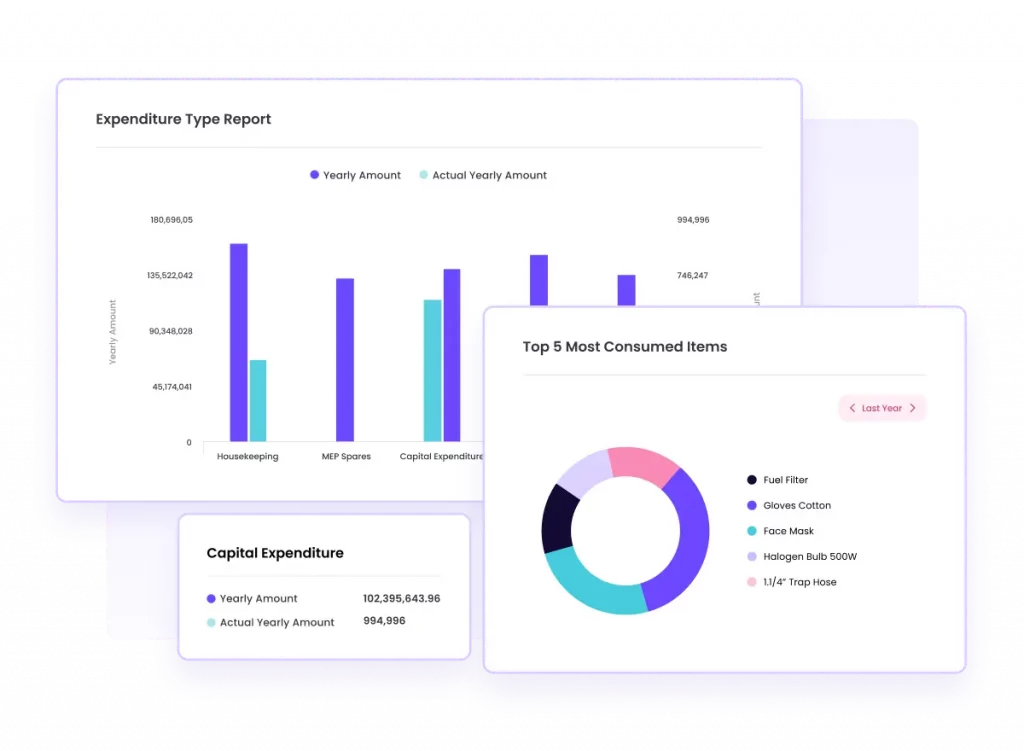
The critical distinction between CMMS inventory management and standalone inventory software is integration. When inventory is managed in a separate system from work orders and asset records, information gaps are inevitable — the parts database does not reflect actual consumption until someone manually updates it, and the maintenance scheduler has no visibility into parts availability when assigning work. CMMS inventory management eliminates these gaps by design, creating a single source of truth where every maintenance action automatically updates the inventory record and every inventory status is immediately visible to the maintenance planning workflow.
Why Inventory Management is Central to Maintenance Excellence
The relationship between inventory management and maintenance performance is direct and measurable. Research consistently shows that CMMS inventory management helps organisations save up to 30 percent on operational costs through reduced emergency procurement, elimination of excess stock carrying costs, and faster first-time fix rates that reduce the labour overhead of repeat maintenance visits.
Beyond cost, inventory management quality determines maintenance velocity. When technicians can confirm parts availability before departing for a job, first-time fix rates improve dramatically — eliminating the wasted travel, rescheduling, and extended downtime that occurs when a technician arrives at a job without the required components. When reorder triggers are automated, stockouts are prevented rather than discovered at the worst possible moment. And when parts consumption is linked to specific assets and work orders, the usage data accumulated over time enables genuinely predictive inventory planning — stocking the right parts at the right levels based on actual maintenance history rather than guesswork.
How FacilityBot Delivers Integrated CMMS Inventory Management
FacilityBot’s CMMS inventory management capability is built on full integration between parts tracking, CMMS asset management, work order management, and procurement — creating the connected operational system that makes inventory control automatic rather than administrative.
- Unlimited parts linked to assets means every spare part in the FacilityBot system is associated with the specific assets it services. When a technician opens a work order for an HVAC unit, the associated parts — filters, belts, sensors, refrigerant — are immediately visible alongside the asset’s maintenance history and service documentation. Parts availability is confirmed before the technician departs for the job, not discovered to be lacking upon arrival.
- Automatic stock updates through work order completion eliminate the manual inventory reconciliation that creates the stock level inaccuracies plaguing spreadsheet-based systems. When a technician marks a work order complete and records parts consumed, FacilityBot automatically deducts those quantities from the inventory record in real time. No separate data entry. No delays between maintenance action and inventory update. The stock level shown in the system is always the stock level that actually exists.
- Automated reorder triggers ensure that minimum stock thresholds generate immediate procurement alerts when reached — preventing the stockouts that delay critical repairs and extending the downtime that reactive inventory management creates. FacilityBot’s procurement module enables facilities teams to manage the full RFQ process within the platform, from soliciting vendor quotes through order tracking and delivery confirmation, all connected to the inventory record that updates automatically upon receipt.
- Unlimited vendor and invoice management provides the supplier relationship infrastructure that effective CMMS inventory management requires. Preferred vendors for specific parts categories, historical pricing records, and invoice histories are all maintained within FacilityBot — enabling faster procurement decisions, better-informed vendor negotiations, and consolidated ordering that reduces procurement overhead across the entire maintenance operation.
CMMS Asset Management: The Foundation of Inventory Intelligence
Effective CMMS inventory management rests on the quality of CMMS asset management that underpins it. The asset register that catalogues every piece of equipment — with its maintenance history, associated parts, service documentation, and performance data — is the foundation from which inventory requirements are understood and planned.

FacilityBot’s unlimited CMMS asset management capability creates this foundation comprehensively. Every asset in the register carries its complete parts consumption history, enabling facility managers to identify which assets generate the highest parts expenditure, which spare parts are consumed most frequently, and where inventory investment will deliver the greatest maintenance performance return.
Asset hierarchy management in FacilityBot links components to systems, systems to locations, and locations to buildings — creating the structured CMMS asset management framework that makes portfolio-wide inventory visibility possible. A facility manager overseeing multiple buildings can see parts consumption and stock levels across every site from a single dashboard, identifying consolidation opportunities and cross-site stock transfers that reduce overall inventory carrying costs.
This asset-level inventory intelligence transforms CMMS asset management from a static record-keeping function into a dynamic planning tool — enabling capital planning decisions, supplier negotiations, and preventive maintenance scheduling that are grounded in real consumption data rather than estimates.
Key CMMS Inventory Management Best Practices
Implementing CMMS inventory management effectively requires more than platform selection. The practices that consistently deliver the greatest inventory control value share five common characteristics.
- Build a comprehensive parts catalogue from the outset. Every part that touches a maintenance workflow — from major mechanical components to consumables like filters and lubricants — should be catalogued in the CMMS with standardised naming conventions, supplier information, and minimum stock thresholds defined. Incomplete catalogues produce incomplete visibility, undermining the accuracy that makes automated reorder triggers reliable.
- Link every part to its associated assets before go-live. The asset-parts association that enables consumption tracking and demand forecasting must be established before the first live work order is processed. Retroactive association is possible but labour-intensive — investing the time upfront pays dividends throughout the system’s operational life.
- Set minimum and maximum stock thresholds based on actual usage data. Initial thresholds set from estimates should be reviewed and refined using the consumption data that FacilityBot accumulates through the first three to six months of live operation. Data-driven thresholds reduce both stockouts and excess carrying costs more effectively than any static estimate.
- Use QR code scanning for real-time field inventory updates. FacilityBot’s QR code capability enables technicians to scan asset tags and parts labels directly from their mobile devices — logging parts consumption at the point of use rather than reconstructing it later. Field-captured data is more accurate, more timely, and more complete than data entered retrospectively.
- Review inventory performance metrics monthly. FacilityBot’s analytics layer generates inventory performance data — stock turnover rates, consumption trends by asset category, procurement lead times, and supplier fill rate performance — that should be reviewed regularly to identify optimisation opportunities. CMMS inventory management is not a set-and-forget capability; it improves continuously as the data accumulated through operational activity is actively analysed and acted upon.
The Operational Return of Integrated CMMS Inventory Management
The cumulative operational impact of effective CMMS inventory management extends well beyond the direct cost savings from reduced emergency procurement and optimised stock levels. Maintenance teams that can rely on confirmed parts availability work with greater confidence and efficiency. Work orders are completed faster when parts are ready rather than pending. Preventive maintenance programmes adhere more consistently to schedule when upcoming parts requirements are identified and procured ahead of time. And compliance documentation is stronger when every parts movement is automatically recorded with a timestamped audit trail.
For Singapore facility managers committed to building a maintenance operation that controls costs, maximises equipment uptime, and demonstrates the transparent operational accountability that building owners and regulatory bodies increasingly expect, integrated CMMS inventory management and CMMS asset management are the foundational capabilities that make those outcomes achievable.
FacilityBot delivers both — completely, from the first day of deployment — as part of Singapore’s most comprehensive facility management platform.
